Australians are increasingly concerned about their privacy and are recognising a broader range of risks, particularly around data security, misuse of personal information, and how data is handled by organisations and digital technologies. While there is strong and growing support for privacy protections, data minimisation, and rights such as access and deletion, many feel they lack understanding, control and genuine choice, with widespread disengagement from privacy policies reinforcing this gap. This points to a clear disconnect between expectations and lived experience, alongside growing demand for greater transparency, accountability and control.
Within this context, privacy remains meaningful in consumer decision-making. Although not the primary driver compared with service quality and price, it consistently ranks ahead of convenience, indicating that many Australians are willing to trade ease or speed for stronger privacy protections. This reflects a broader shift towards more privacy-conscious behaviour, particularly among those with higher levels of concern about how their personal information is handled.
Shift in privacy concern overtime
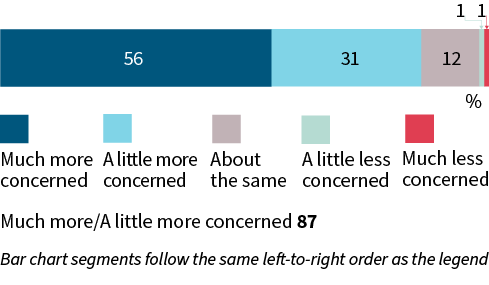
Compared with 5 years ago, Australians are more concerned about their privacy, with almost 9 in 10 (87%) saying they are a little or much more concerned.
Increased concern about personal privacy is more pronounced among women than men (90% vs 83%).
Figure 1 Concern about privacy compared to 5 years ago
G14. Compared with 5 years ago, how concerned are you about your privacy now?
Base: All Australians aged 18+. (n=1,504)
Notes: Don’t know (<0.5%) and refused (0%) not displayed.
Perceived privacy risks
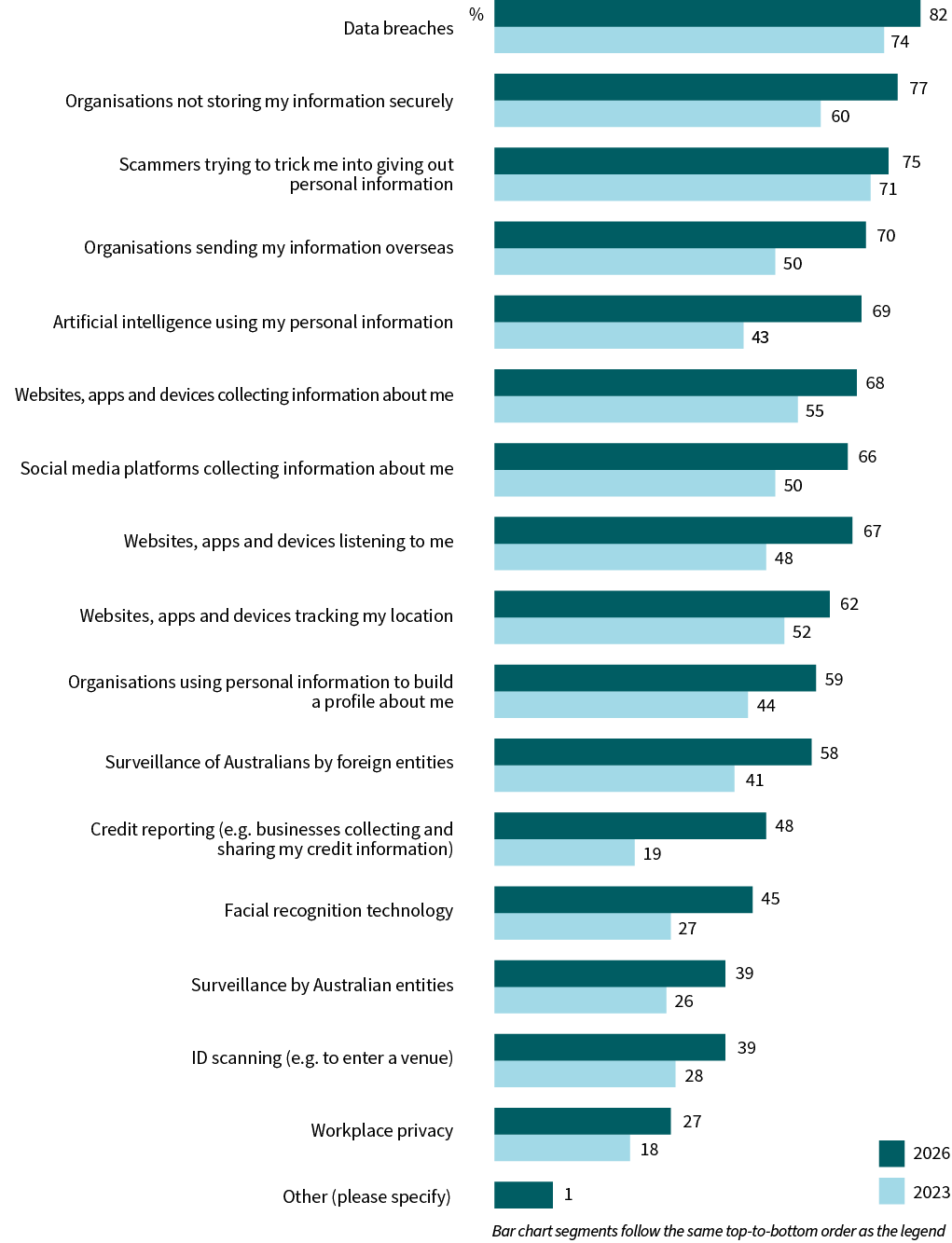
Overall, Australians identify a broader range of privacy risks in 2026 than in 2023, with increases observed across all measures of perceived privacy risk presented in the survey. This suggests privacy concerns are becoming more common and broader, going beyond single incidents to include wider concerns about how personal information is collected, used and managed. Data security failures and misuse of personal information remain the most commonly mentioned risks, with concern focused on organisational practices as well as external threats such as scams. There is also broader unease about how personal information is collected, shared and used across digital platforms and emerging technologies, including AI.
The biggest privacy risks identified by Australians include:
- data breaches (82%, up from 74% in 2023)
- organisations not storing personal information securely (77%, up from 60% in 2023)
- scammers attempting to access personal information (75%, up from 71% in 2023)
- organisations sending information overseas (70%, up from 50% in 2023)
- concern about AI systems using personal information (69%, up from 43% in 2023).
Together, these findings suggest that perceived privacy risks are linked to weaknesses in organisational systems, poor information handling and security by organisations, and harmful actions by outside parties.
Australians with higher overall privacy concern tend to identify a wider set of privacy risks. This group is more likely to include people who:
- have previously had concerns about how organisations handle their personal information
- feel they have little or no control over how their information is collected and used
- report rarely or never having a choice about sharing personal information.
Awareness of recent data breaches in Australia is associated with higher concern about data breaches, regardless of whether individuals were personally affected, suggesting that public visibility of incidents may shape perceptions of risk.
Concern about organisations not storing information securely is more pronounced among Australians aged 50+ (86% vs 70% of those aged 18–49) and among English‑only speakers (81% vs 67% of those who speak a language other than English at home), indicating variation in how privacy risks are perceived across population groups.
Figure 2 Perceived privacy risks
P1. What do you think are the biggest privacy risks that you face today?
Base: All Australians aged 18+. (2026: n=1,504, 2023: n=1,626)
Notes: Don’t know (1%) and refused (<0.5%) not displayed. “Credit reporting” label was updated to “Credit reporting (e.g. businesses collecting and sharing my credit information)” in 2026, so comparisons with 2023 should be interpreted with caution.
Beliefs about protecting personal information and expectations for organisations to act fairly
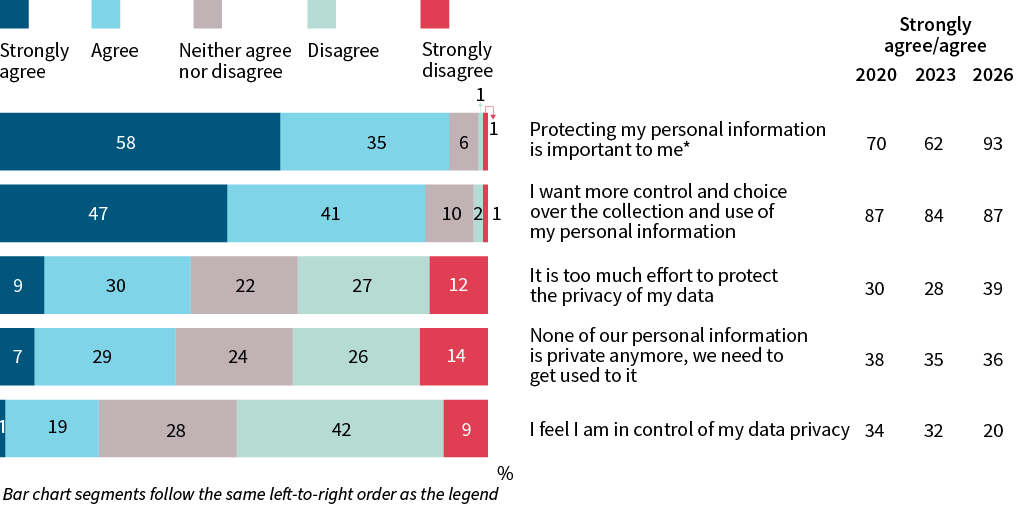
Australians place a very high value on data privacy and express strong expectations for greater control over how their personal information is handled. Almost 9 in 10 agree or strongly agree that:
- protecting their personal information is important (93%, up from 62% in 2023). Comparison with 2023 should be interpreted with caution due to changes in question wording (2023 wording: “Protecting my personal information is a major concern in my life”)
- they want more control and choice over how their data is collected and used (87%, up from 84% in 2023).
At the same time, perceptions of control appear more limited, suggesting a gap between expectations and lived experience. Individual responsibility and agency for protecting privacy is becoming more complex, with individuals appearing increasingly fatalistic about their privacy as shown by the following.
- A growing share of Australians agrees that protecting their privacy is too much effort (39% vs 28% in 2023).
- Fewer Australians report feeling in control of their data privacy, with only 1 in 5 (20%) agreeing that they are in control, down from 32% in 2023.
Taken together, these patterns suggest increasing concern about privacy alongside declining confidence in individuals’ ability to manage their personal information.
Perceptions that protecting personal information requires too much effort are more commonly reported among Australians aged 18–34 (48% compared with 33% of those aged 50+), people living in capital cities (42% vs 33% outside capital cities), those with tertiary education (47% vs 34% with vocational qualifications), and those who speak a language other than English at home (51% vs 35% of English‑only speakers).
Figure 3 Beliefs around control over personal information
G5. Thinking about data privacy, to what extent do you agree or disagree with the following?
Base: All Australians aged 18+. (2026: n=1,504, 2023: n=1,916, 2020: n=1,505)
Notes: Don’t know (0%) and refused (0%) not displayed.
Australians strongly believe that organisations which collect or hold their personal information should be responsible for protecting it. This includes using privacy-protective default settings and limiting how much information they collect.
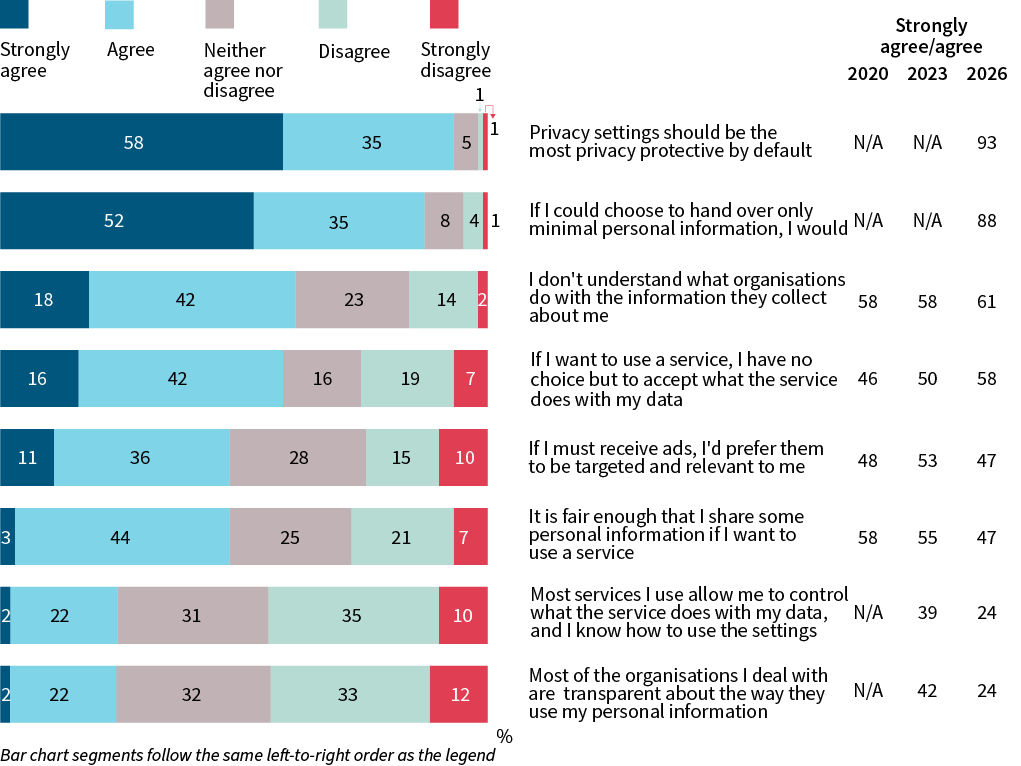
Around 9 in 10 Australians agree or strongly agree that:
- privacy settings should be most protective by default (93%)
- they would choose to share only minimal personal information (88%).
At the same time, many feel uncertain and constrained, with 3 in 5 agreeing they do not understand how organisations use their data (61%), and they have no choice but to accept data practices to access services (58%, up from 50% in 2023).
Attitudes towards accepting privacy trade-offs for convenience or personalisation are mixed, with less than half agreeing or strongly agreeing that:
- they would prefer targeted ads if they must receive ads (47%, down from 53% in 2023)
- it is fair to share some data to use services (47%%, down from 55% in 2023).
Perceived control and transparency remain low, with only about a quarter agreeing or strongly agreeing that:
- they can control how most services use their data through settings (24%, down from 39% in 2023)
- most organisations are transparent about how personal information is used (24%, down from 42% in 2023).
This highlights a clear gap between Australians expectations for privacy and perceptions of current practices by organisations entrusted with their personal information.
Australians are more likely to think it is fair to share personal information to use a service when they also feel they have choice and control over how their information is handled. This includes those who:
- feel they have some or a great deal of control over how their personal information is collected and used (57% vs 44% of those feel very little or no real control)
- feel that sharing personal information is always, often or sometimes a real choice in everyday situations (53% vs 44% of those feel rarely or never a choice).
Older Australians aged 50+ (56% vs 40% of those aged 18–49) and those living outside capital cities (51% vs 45% of those in capital cities) are more likely to prefer targeted and relevant advertising.
Limited understanding of how organisations use personal information is also higher among those aged 25–34 (65%) and 65+ (67%), compared to 49% of those aged 18–24 and 55% of those aged 50–64.
Perceived transparency in how organisations handle personal information is higher among older Australians aged 65+ (36% vs 21% of those aged 18–64) and those without formal qualifications (33% vs 24% average Australian).
Figure 4 Beliefs about organisations’ personal information handling practices
G6. Thinking about data privacy, do you agree or disagree with the following?
Base: All Australians aged 18+. (2026: n=1,504, 2023: n=1,916, 2020: n=1,505)
Notes: Don’t know (0%) and refused (0%) not displayed.
* Comparison with 2023 should be interpreted with caution due to changes in question wording (2023 wording: “Protecting my personal information is a major concern in my life”)
Engagement with privacy policies
Around 7 in 10 Australians (69%) report that they always or often agree to a company’s privacy policy without reading most or all of it in the past 12 months, particularly those aged 18–64 (72% vs 58% of those aged 65+) and those living in capital cities (71% vs 64% outside capital cities).
Those who always or often accept privacy policies without reading them are just as likely as the average Australian to say they are more concerned about privacy than they were 5 years ago (87%). This suggests that routinely accepting privacy policies without reading them may not necessarily reflect low concern about privacy, but could instead be associated with feelings of limited choice or control. Compared with those who read privacy policies at least sometimes, this group is more likely to:
- report limited understanding of how organisations use their personal information (63% vs 56%)
- feel that consent (73% vs 56%) or sharing personal information (72% vs 51%) is rarely or never a real choice
- feel they have little or no control over how their data is collected and used (82% vs 69%)
- accept sharing personal information because not sharing them would mean missing out on essential services or opportunities (57% vs 40%)
- agree that privacy settings should be most protective by default (95% vs 89%)
- prefer minimal data collection (90% vs 82%).
Taken together, these findings indicate people feel reading privacy policies does not meaningfully change outcomes, particularly when services are seen as essential or opting out is difficult. This aligns with broader concerns about whether current data practices provide Australians with meaningful choice and control, and with expectations for stronger organisational privacy protections.
Figure 5 Agreeing to a company’s privacy policy without reading it in the past 12 months
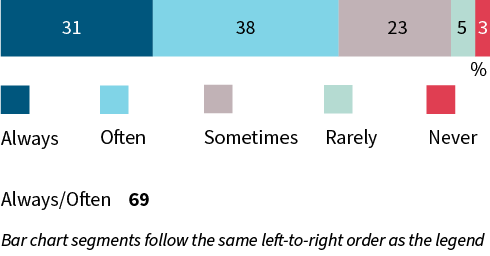
L10. In the past 12 months, how often have you agreed to a company's privacy policy without reading most or all of it?
Base: All Australians aged 18+. (n=1,504)
Notes: Don’t know (0%) and refused (0%) not displayed.
Australians want a wide range of information included in privacy policies, with more than 2 in 5 (43%) saying all listed information should be included, a continued increase from 2023 (29%) and 2020 (23%). Older Australians aged 50+ are more likely than those aged 18–49 to expect all listed information to be included in privacy policies (49% vs 39%).
Commonly expected inclusions are:
- what kind of personal information is collected and held (43%)
- how personal information is collected, used, stored and protected (42%)
- how long personal information is retained (42%)
- why personal information is collected, held and disclosed (41%)
- whether personal information is likely to be shared with overseas organisations and in which country (38%)
- how to access and correct information (37%)
- a simple explanation of privacy rights (35%)
- what happens if there is a data breach (34%)
- how to complain about a privacy breach (32%)
- if some activities of an organisation are exempt from the Privacy Act (28%)
- how to deal anonymously with the organisation (19%).
Figure 6 Information should be included in all privacy policies
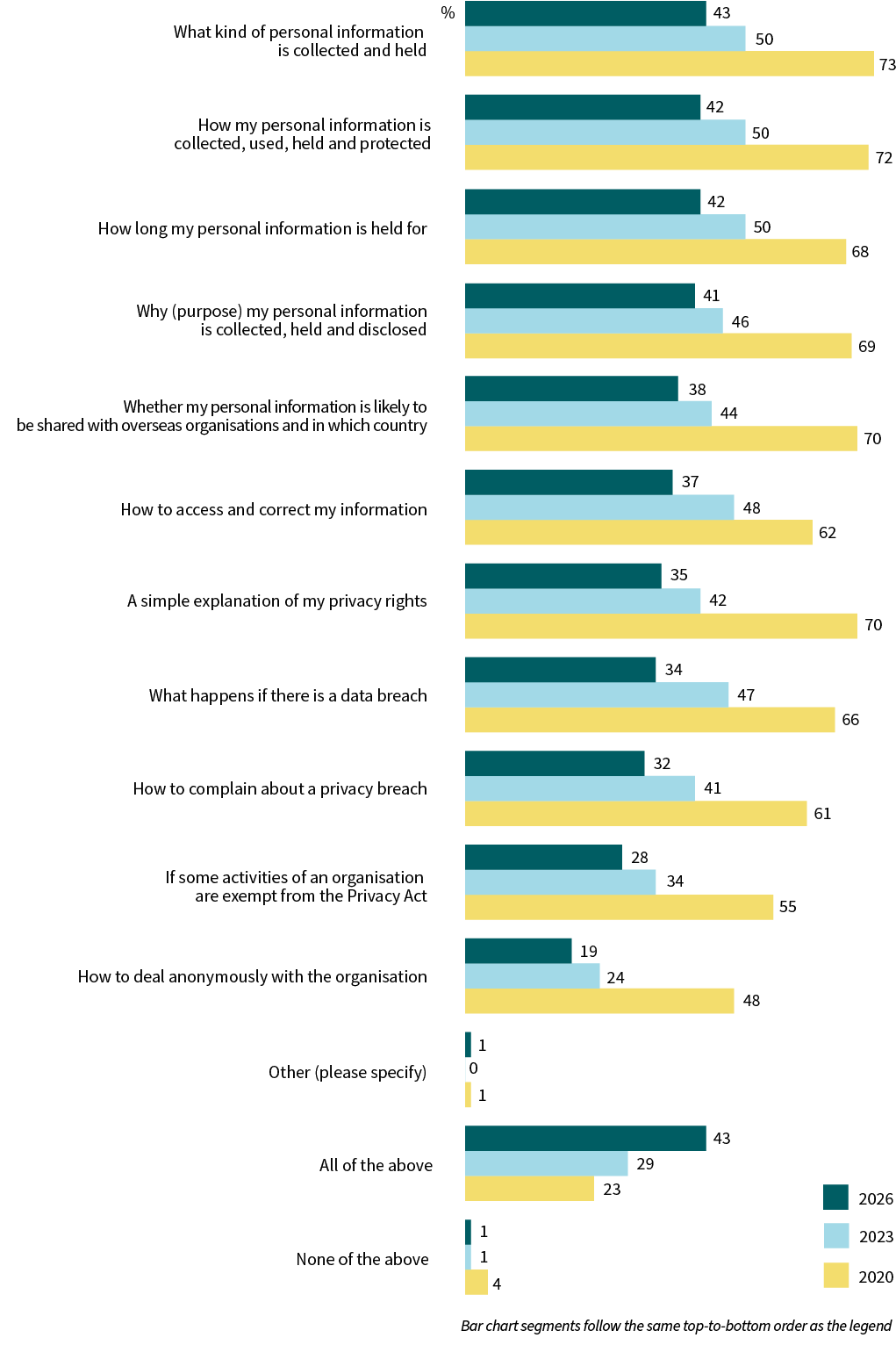
L8. Some people think that privacy policies should be as short as possible, others think they should be comprehensive. With this in mind, which of the following do you think should be in all privacy policies?
Base: All Australians aged 18+. (2026: n=1,504, 2023: n=1,653, 2020: n=1,505)
Notes: Don’t know (<0.5% in 2026) and refused (0%) not displayed.
Awareness and use of consumer privacy rights
When considering the personal information held by organisations such as banks, energy providers and telecommunications companies, many Australians report limited visibility and control over how their data is managed. Overall, the findings suggest that a substantial proportion of the general community has only partial insight into what personal information organisations hold about them and how it can be accessed.
Two in 5 Australians (40%) report that they do not really know what personal information organisations hold about them or how to access it. A further quarter (24%) indicate they have only partial access, with limited control over their information. These results suggest that clear and effective access to personal information is not consistently experienced across the population.
The following groups are more likely to say they do not really know what personal information organisations hold about them or how to access it:
- Australians aged 50+ (46% vs 35% of Australians aged 18–49)
- English-only speakers (43% vs 30% of those who speak a language other than English at home).
Australians who do not really know what personal information organisations hold about them or how to access it are also more likely to:
- be unaware they can request access to their personal information (51% vs 26% of those who are aware)
- say they have never requested access to their personal information (30% vs 12% of people who have requested access).
Figure 7 Experience with organisations holding personal information
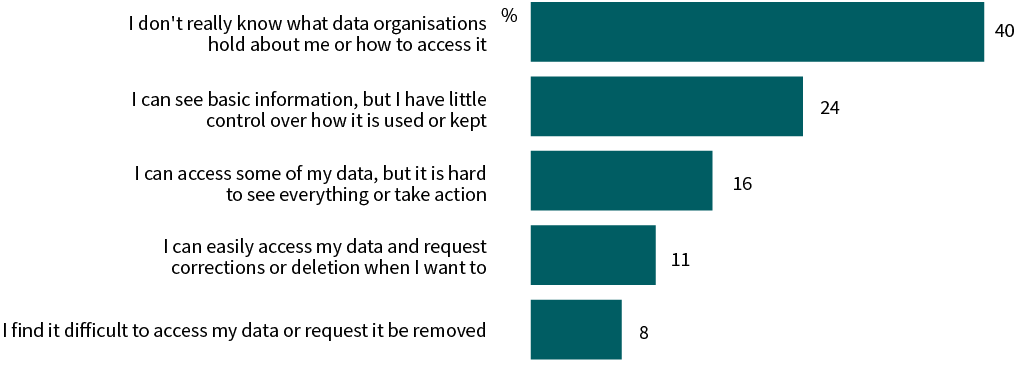
L3. Thinking about the personal information organisations hold about you (such as banks, energy providers or telcos), which statement best describes your experience?
Base: All Australians aged 18+. (n=1,504)
Notes: Don’t know (0%) and refused (0%) not displayed.
It is highly relevant then that less than half of all Australians (45%) are aware they have the right to request access to their personal information from organisations, and barely one in 10 (11%) report having done so, consistent with 2023 results.
Awareness of this right in legislation is lower among Australians aged 65+ (34% vs 48% of those aged 18–64).
Some groups are more likely to have requested access to their personal information, including:
- Australians aged 18–24, who are around 3 times more likely than those aged 25+ to have done so (27% vs 9%)
- those who speak a language other than English at home (15% vs 9% of English-only speakers).
Australians who are aware of this right, or who have requested access to their personal information, are also more likely to report feeling some or a great deal of control over how their personal information is collected and used.
Figure 8 Access to personal information held by organisations
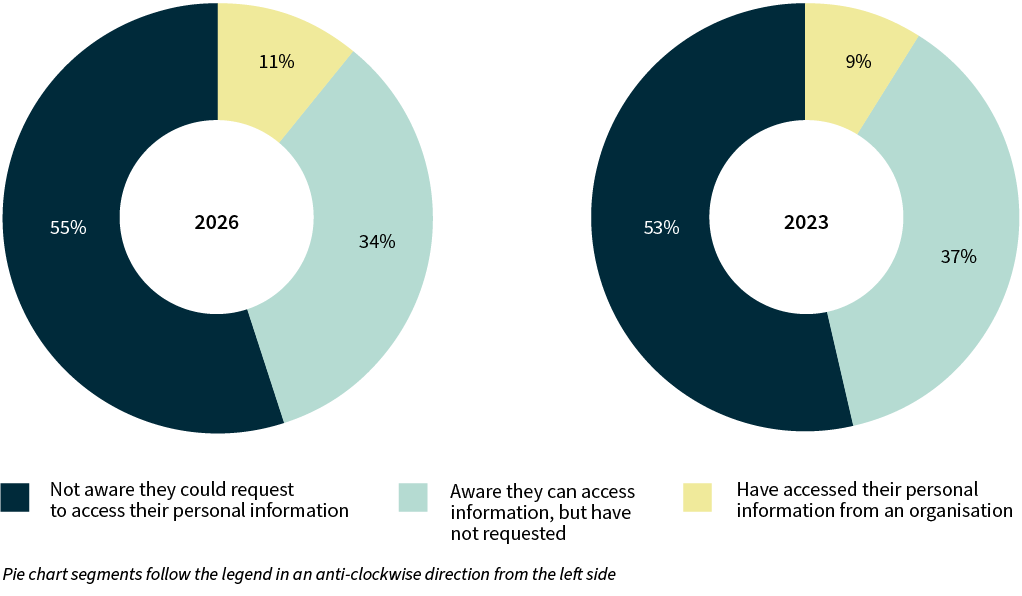
L4. Are you aware that you can request to access your personal information from organisations? L5. Have you ever requested to access your personal information from an organisation?
Base: All Australians aged 18+. (2026: n=1,504, 2023: n=1,653)
Notes: Don’t know (0%) and refused (0%) not displayed.
Support for data deletion and erasure
Australians show strong support for the right to data deletion and erasure. More than 9 in 10 (93%) support or strongly support a legal right for individuals to request that organisations delete their personal information, including almost three-quarters (73%) who strongly support this provision.
Support is stronger among Australians aged 50+ (97% vs 90% of those aged 18–49), those who are more concerned about their privacy than 5 years ago (94% vs 83% of those less concerned or about the same), and those aware of a data breach in the past 12 months (95% vs 88% of those unaware).
Figure 9 Support for a legal right to request deletion of personal information
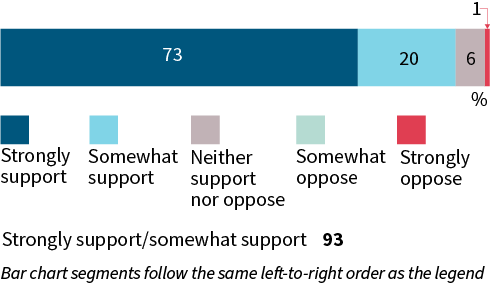
DEL1. How strongly do you support or oppose a legal right for individuals to request that organisations delete their personal information?
Base: All Australians aged 18+. (n=1,504)
Notes: Don’t know (0%) and refused (0%) not displayed.
When Australians ask an organisation to delete their personal information, most expect this to result in complete and irreversible removal:
- Around 7 in 10 (72%) expect their information to be permanently deleted.
- Over half (52%) expect the organisation to stop using the information for any purpose.
- Under half (45%) expect that the information cannot be restored or linked back to them.
- Two in 5 (40%) expect information to be removed from active systems but potentially retained for a limited period, such as for backups or legal requirements.
Younger Australians aged 18–34 are more likely than those aged 35+ to expect that deletion of personal information means:
- the organisation stops using it for any purpose (64% vs 47%)
- the information cannot be linked back to them (55% vs 40%)
- the information is removed from active systems, even if retained for a limited period (48% vs 36%).
Figure 10 Expectations when requesting deletion of personal information
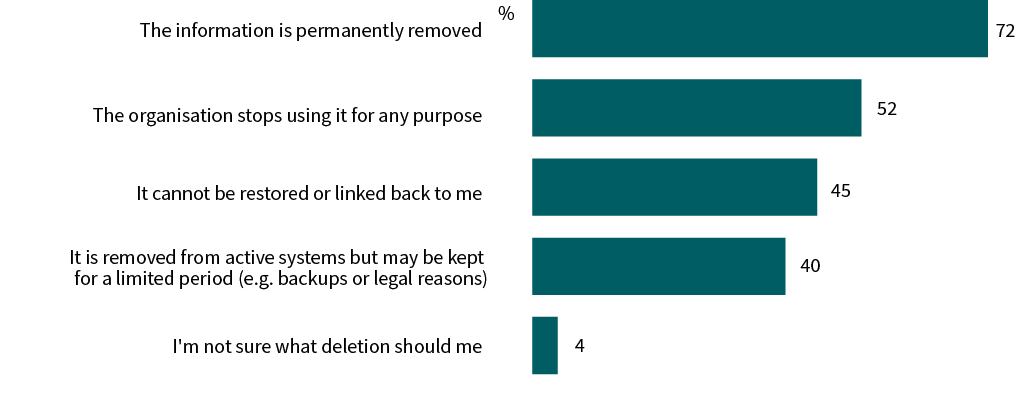
DEL2. When you ask an organisation to delete your personal information, what do you expect should happen?
Base: All Australians aged 18+. (n=1,504)
Notes: Don’t know (0%) and refused (0%) not displayed.
Role of privacy in consumer decision-making
Quality, price and reliability continue to be the primary factors influencing Australians’ choice of products and services, although their relative importance has shifted over time. Australians are most likely to rank the following among their top 3 considerations:
- quality of service (63%)
- price (54%, down from 62% in 2023)
- reliability (50%, up from 33% in 2023)
- overall reputation (41%).
While privacy is not a primary driver of choice, it remains an important consideration when choosing products and services. Australians are more likely to rank privacy-related factors than convenience-related factors among their top 3 considerations, suggesting that many Australians may be willing to trade some convenience for stronger privacy protections:
- trust in an organisation’s ability to keep personal information secure (33%)
- organisations that collect as little personal information as possible (25%)
- making life easier (20%, down from 25% in 2023)
- speed of access (10%).
The prioritisation of privacy also varies by attitudes and behaviours, and privacy‑related decision‑making is shaped by broader orientations toward privacy and engagement with information practices.
- Australians who are more concerned about their privacy than 5 years ago are more likely to rank information security among their top 3 factors (34% vs 25% of those with the same or lower level of concern).
- Those who routinely accept privacy policies without reading them are less likely to rank both data security (28% vs 44% of those who read them at least sometimes) and data minimisation (21% vs 33%) among their top 3 considerations.
Australians also place a high and increasing level of importance on how their personal information is collected, used and protected when choosing a product or service.
- Nearly 9 in 10 say it is important their personal information is protected (89%, up from 86% in 2023).
- More than 4 in 5 say it is important they are not asked for more personal information than necessary (85%, up from 81% in 2023).
- More than 4 in 5 say it is important they are clearly told how their personal information will be used (82%, up from 79% in 2023).
Australians aged 50+ are more likely than those aged 18–49 to place high importance on not being asked for more personal information than needed (89% vs 81%). Women are also more likely than men to say that having their personal information protected (69% vs 62%) and being clearly informed about how it will be used (54% vs 46%) are extremely important.