-
On this page
Overall, awareness of the Office of the Australian Information Commissioner (OAIC) and the Privacy Commissioner is mixed, with many Australians recognising the name but having limited understanding of its role.
At the same time, there is strong and growing support for strengthening privacy protections. Australians broadly favour extending the Privacy Act obligations to currently exempt sectors and consistently support enhanced individual rights, particularly the right to have organisations delete personal information held about them. Together, these findings highlight a receptive environment for the OAIC to build awareness, reinforce its relevance, and play a more prominent role in shaping public understanding and trust in privacy governance.
Awareness of the Privacy Commissioner
Australians show mixed awareness of the OAIC. Nearly half of the Australian community (49%) are aware of the OAIC. Only one in 10 (9%) say they are familiar with its role.
In 2023, fewer people – just under 2 in 5 (38%) – were aware that the OAIC exists to uphold privacy laws and investigate complaints about the misuse of personal information. However, due to differences in question framing, the results are not directly comparable across years.
Awareness of the OAIC is higher among:
- older Australians aged 55+ (59% vs 40% of those aged 18–45)
- English-only speakers (53% vs 36% of those who speak a language other than English at home).
Support for changes to the Privacy Act
There is strong support among Australians for extending Privacy Act obligations to sectors that are currently exempt, suggesting broad expectations that personal information should be handled consistently across the economy.
Support is highest for applying the same privacy standards to:
- businesses collecting employee data, including monitoring or surveillance (89% vs 81% in 2023, 73% in 2020)
- political parties and representatives (88% vs 82% in 2023, 74% in 2020).
Support remains high for extending privacy regulation to:
- media organisations (84% vs 78% in 2023, 72% in 2020)
- small Australian businesses (80% vs 71% in 2020).
Women are consistently more likely than men to support applying the same privacy standards across sectors, including:
- businesses collecting work‑related employee information (91% vs 86%)
- political parties and representatives (91% vs 86%)
- media organisations (87% vs 82%)
- small Australian businesses (84% vs 76%).
Figure 11 Belief that organisation types should be covered by the Privacy Act
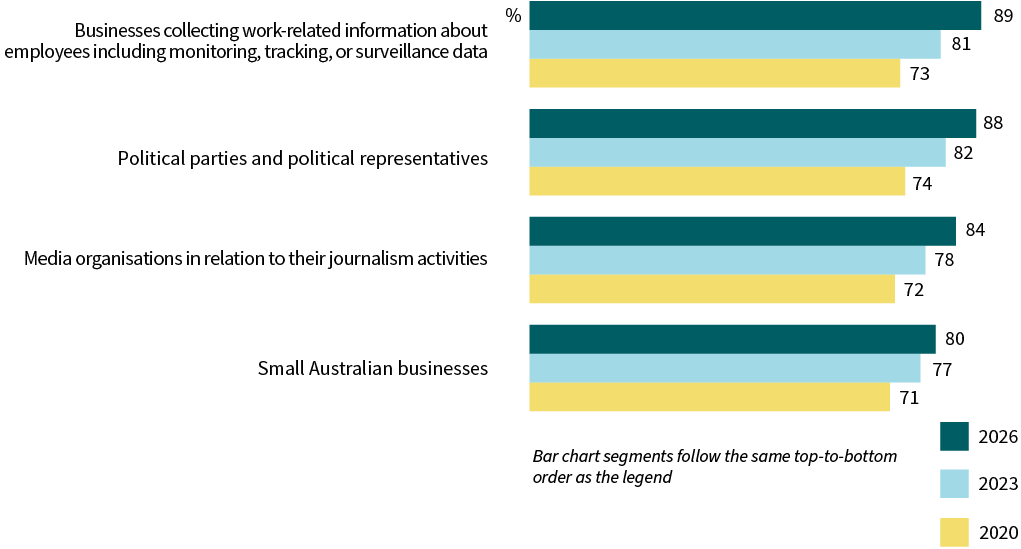
L2. The following sectors are currently exempt from the Australian Privacy Act. Should they have to handle your personal information in the same way as Australian Government agencies and larger businesses?
Base: All Australians aged 18+. (2026: n=1,504, 2023: n=1,653, 2020: n=1,509)
Notes: Don’t know (0%) and refused (all <0.5%) not displayed.
Australians strongly support the introduction of additional individual rights under the Privacy Act, including the right to:
- ask a business to delete their personal information (95%, up from 93% in 2023)
- object to certain data practices while continuing to access services (92%)
- be informed when their personal information is used in automated decision-making (91%)
- seek compensation for a breach of privacy (88%).
- request that government agencies delete their personal information (75%, down from 79% in 2023).
Figure 12 Specific rights should be included under the Australian Privacy Act
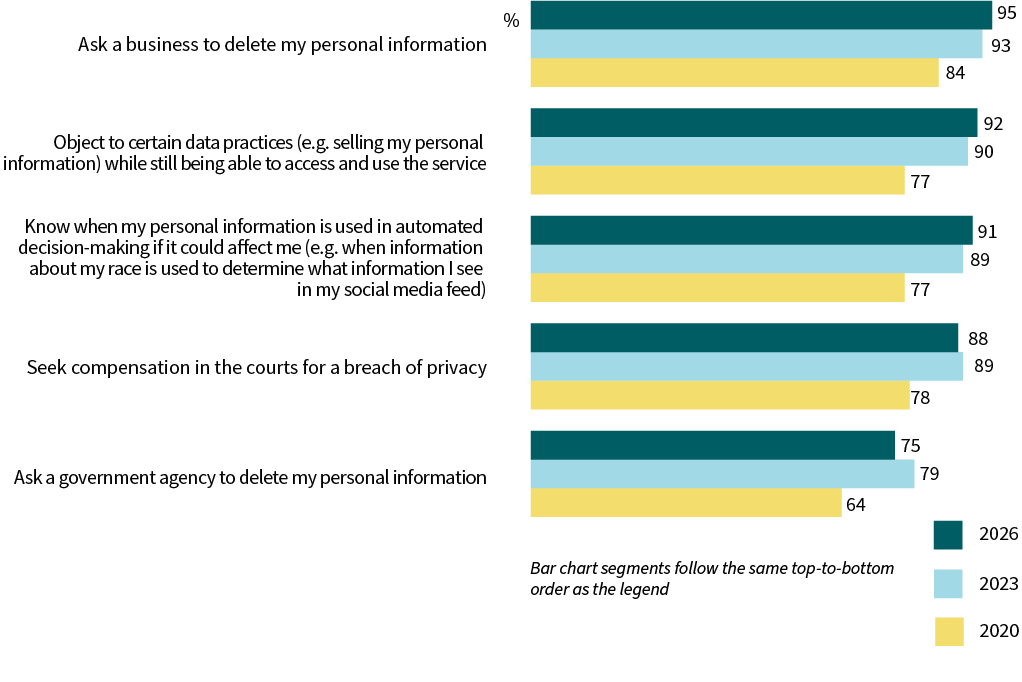
L6. Do you believe you should have these rights under the Australian Privacy Act?
Base: All Australians aged 18+. (2026: n=1,504, 2023: n=1,653, 2020: n=1,509)
Notes: Don’t know (1% in 2026, between 8% and 11% in 2023, between 16% and 17% in 2020) and refused (all <0.5% in 2026) not displayed.