-
On this page
Trust in organisations to protect and use personal information varies markedly by sector, with strongest confidence in essential and public-facing services such as health, government and financial institutions. Weaker trust was recorded in commercial, digital and data-driven industries including AI, social media companies and data brokers. At the same time, Australians are becoming more selective about what personal information they consider fair to share, generally limiting acceptance to basic details and situations where there are a clear purpose and a trusted context.
This cautious approach also extends to government data use, where Australians are more comfortable when information is used to deliver services or public benefit, but less accepting of practices that lack transparency, involve identifiable data, or are not clearly communicated, highlighting the importance of trust, purpose and control.
Trustworthiness of organisations by sector
Trust in organisations to protect and appropriately use personal information varies markedly by sector.
Health service providers are the most trusted industry sector, with 74% of Australians viewing them as trustworthy. Trust is also higher for sectors linked to public services and regulated handling of personal information, including:
- government agencies (68%)
- financial institutions (59%)
- education providers (57%, down from 61% in 2023).
Trust is more mixed across some commercial sectors, with confidence declining over time in several industries:
- insurance companies (28%, down from 40% in 2023)
- telecommunications providers (24%, down from 37% in 2023)
- technology companies (17%, less than half of 39% in 2023).
- real estate agencies (13%, nearly half of 23% in 2023)
- retailers (10%, around a third of 30% in 2023).
The lowest levels of trust are reported for data-driven sectors whose core activities involve large-scale data collection and analysis:
- data brokers (4%)
- AI companies (4%)
- social media companies (3%, down from 14% in 2023).
Trust and distrust also vary across population groups:
- Australians aged 65 and over are more likely than those aged 18–64 to trust telecommunications providers (35% vs 21%).
- Men are more likely than women to view data brokers (78% vs 69%), real estate agencies (66% vs 57%), and insurance companies (44% vs 37%) as untrustworthy, while women are more likely than men to trust education providers (61% vs 53%).
Figure 13 Trust in organisations to protect and use personal information
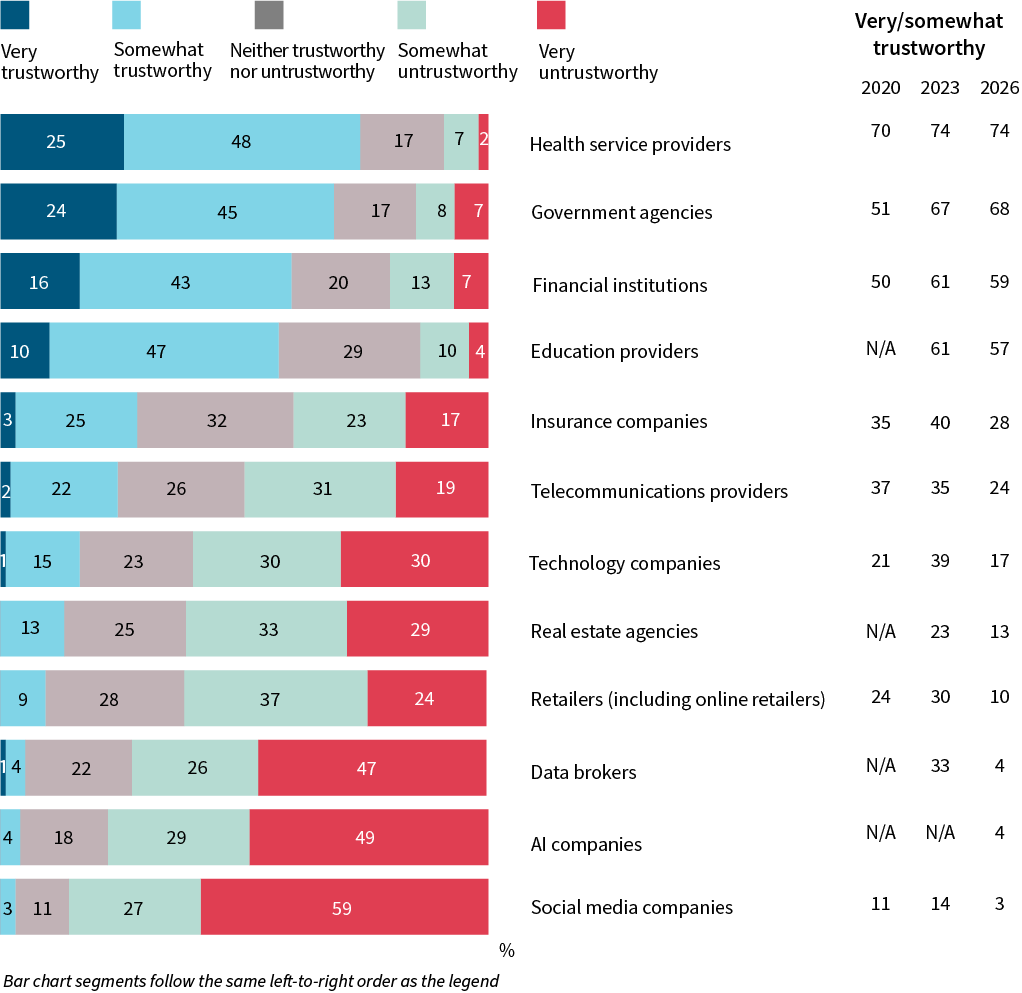
F1. Thinking now about trustworthiness, how trustworthy would you say the following organisations are with regard to how they protect and use your personal information?
Base: All Australians aged 18+. (2026: n=1,504, 2023: n=1,642, 2020: n=1,505)
Notes: Don’t know (all <1%) and refused (all <0.5%) not displayed. “Credit reporting bodies (e.g. Equifax, Illion, Experian)” label was updated to “Data brokers (e.g. Acxiom, Experian Marketing Services, Quantium, companies that buy and sell consumer data)” in 2026, so comparisons with 2023 should be interpreted with caution.
Expectations of fair and reasonable data collection by sector
Respondents were shown a list of different types of personal information and asked what they considered fair and reasonable to provide when accessing services in specific sectors. Compared with 2023, the proportion of Australians who say none of the listed types of personal information are fair and reasonable to provide has doubled (12%, up from 6%), suggesting growing caution about sharing personal information when accessing services across industries.
Australians are most likely to consider basic contact and identity information fair and reasonable to provide, including:
- email address (85%)
- name (85%, down from 90% in 2023)
- phone number (78%, down from 82%)
- date of birth and address (both 72%, down from 78%)
- identification documents (e.g. driver’s license, passport) (52%).
Acceptance has declined for the collection of more sensitive or behavioural data:
- data on how they access, use or interact with services (35%)
- marital status (32%, down from 38%)
- Medical or health information (31%)
- financial information (29%, up from 25%)
- location data (28%).
The lowest levels of acceptance are for highly sensitive or intrusive data, including:
- sexual orientation and biometric information (e.g. fingerprints, facial images) (both 11%)
- social media identifiers (e.g. profile links, usernames, social media activity) (10%)
- religion (9%)
- behavioural or psychological data about interests, habits, likes and dislikes (8%)
- detailed website or app tracking data (e.g. pages viewed, clicks, browsing behaviour across sites) (7%).
Men are more likely than women to consider biometric information being fair and reasonable to provide (14% vs 8%). Younger Australians aged 18–24 are more likely to view social media identifiers as acceptable (24% vs 8% of those aged 25+), while those aged 65+ are more likely to consider location data fair and reasonable (38% vs 25% of those aged 18–24).
Across sectors, basic contact and identity information, such as email address and name, are the most widely accepted data types to provide, particularly for financial institutions, Government agencies and health service providers, where additional information such as phone number and date of birth are also commonly seen as reasonable, and more sensitive data aligns with context (e.g. financial information for banks and health information for healthcare providers). Telecommunications and insurance providers follow a similar but slightly lower pattern, with strong acceptance of core details but more limited acceptance of sensitive data. In contrast, retailers and real estate agencies see lower acceptance beyond basic contact information, while technology companies and social media platforms have the narrowest acceptance overall, with users largely restricting what they consider reasonable to share and showing comparatively higher resistance across most data types.
Figure 14 Information considered fair and reasonable to provide when accessing services by industry sector
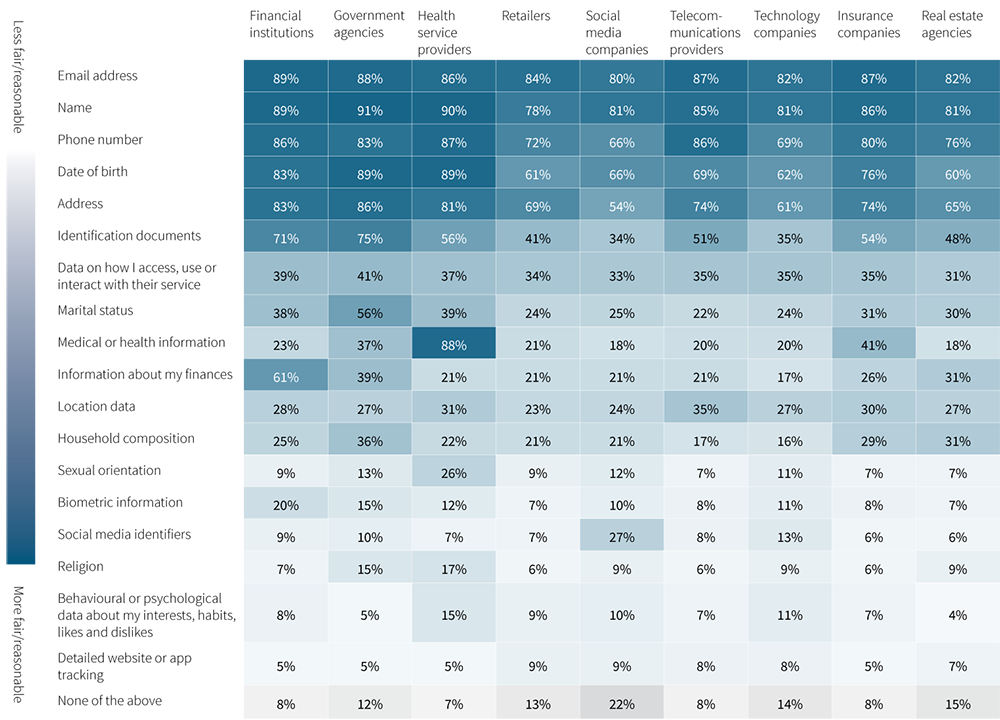
F2. What information would you consider to be fair and reasonable to provide to when accessing their services? (Merged F2A, F2B)
Base: Financial institutions (n=339), government agencies (n=322), Health service providers (n=330), Retailers (n=336), Social media companies (n=333), Telecommunications providers (n=335), Technology companies (n=328), Insurance companies (n=342), Real estate agencies (n=343).
Notes: Prefer not to say (0%) and unsure (all <0.5%) not displayed.
Comfort with government use of personal information and data linking
Australians are more comfortable with cross agency data use when it is framed around service delivery, improvement, safety, or deidentification. Australians are more likely to feel comfortable or very comfortable with:
- sharing information with another agency to deliver a requested service (64%)
- agencies link information across departments to improve services (59%)\
- linking information to detect fraud or unlawful activity (56%)
- linking information to be used in a deidentified form (55%).
Comfort declines when the purpose is research or policy development, with only 36% feeling comfortable. Views are more divided in this context, suggesting uncertainty or mixed acceptance when data use is less directly connected to immediate personal benefit, public good or clear protections. Australians are least comfortable with practices that reduce transparency or increasing identifiability:
- Only one-quarter (24%) are comfortable with government agencies linking information in a way that identifies them personally.
- 72% feeling uncomfortable when linking occurs without directly informing the individual at the time.
Figure 15 Comfort with government agencies’ use of personal information
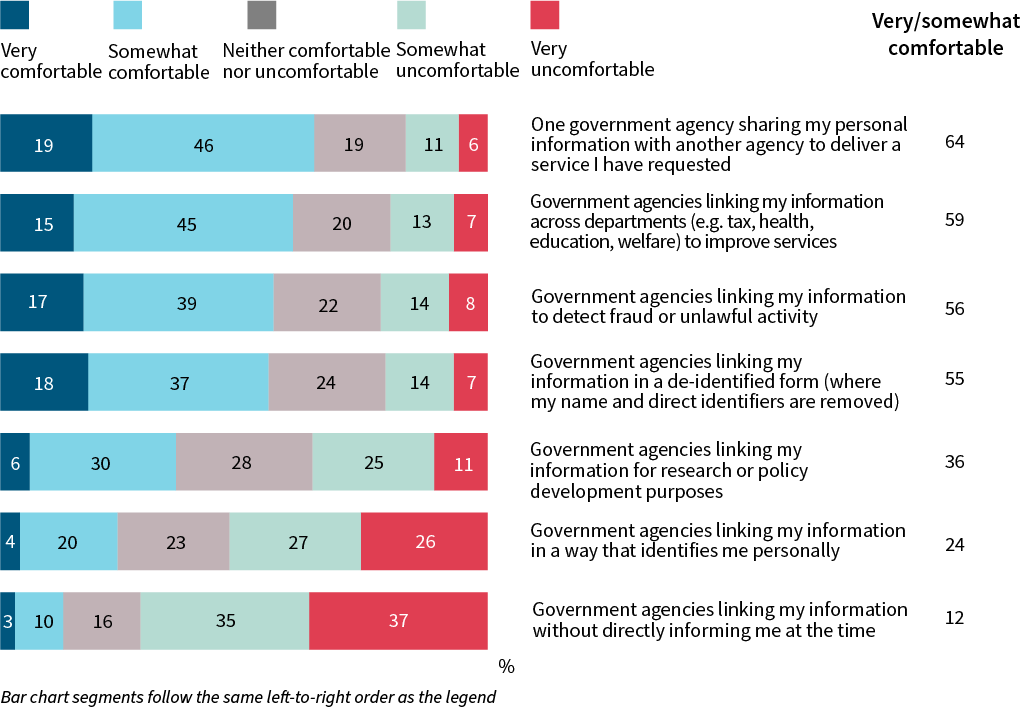
F7. How comfortable are you with the following uses of your personal information by government agencies?
Base: All Australians aged 18+. (n=1,504)
Notes: Don’t know (all <0.5%) and refused (0%) not displayed.