-
On this page
This section explores how Australians think about the trade-offs involved in sharing personal information for convenience, and what they expect in return.
Overall, Australians are sensitive to when the balance of this exchange feels unfair, particularly when they lack choice, clarity or perceive that organisations benefit more than they do. At the same time, most believe these trade-offs could be reduced through better system and service design, rather than accepted as a necessary part of digital services. Importantly, greater confidence that personal information is handled fairly and responsibly would increase willingness to engage with services that require data sharing, highlighting the central role of trust in shaping participation.
When convenience-driven data sharing feels unfair
Australians are attuned to fairness when sharing personal information for convenience, such as saving time, efforts, or making services easier to use.
Australians are more likely to view data sharing as unfair when:
- too much personal information is collected (81%)
- there is limited ability to opt out (77%)
- the benefits mainly favour organisations rather than individuals (70%)
- the risks are not clearly explained (69%).
Those who feel that sharing personal information or providing consent is rarely or never a genuine choice are more likely to identify a broader range of situations in which such data sharing feels unfair, although the relative order of concerns is similar to that observed across the overall population.
Perceived inevitability of privacy trade-offs
Most Australians believe that privacy trade-offs in data practices (i.e. giving up personal information for convenience or services) could be reduced through better system and service design.
Around 3 in 5 (61%) say these trade-offs are often or almost always avoidable, including 22% who say they are almost always avoidable and 39% who say they are often avoidable. This is also reflected by the 52% who accept sharing personal information because they might otherwise miss out on essential services or opportunities.
Older Australians aged 65+ (33% vs 19% of those aged 18–64) and English-only speakers (23% vs 17% of those who speak a language other than English) are more likely to believe that privacy trade-offs in data practices are almost always avoidable through better design. This view is also more common among those who feel they have very little or no control over how their personal information is collected and used, and among those who feel that consent and sharing personal information are rarely or never a genuine choice.
Impact of fair data practices on service uptake
If Australians had more confidence in how their personal information is handled, they would be more willing to use digital services or programs that require them to share it. Around two-thirds (68%) say they would be more likely to use such digital services if they felt their data was handled fairly and responsibly, while around one-quarter (26%) say it would make no difference.
Younger Australians aged 18-24 (30% vs 16% of those aged 25+) are twice as likely to say they are much more likely to use digital services if they feel more confident that their personal information will be handled fairly and responsibly.
Figure 39 Likelihood of using digital services if confident personal information is handled responsibly
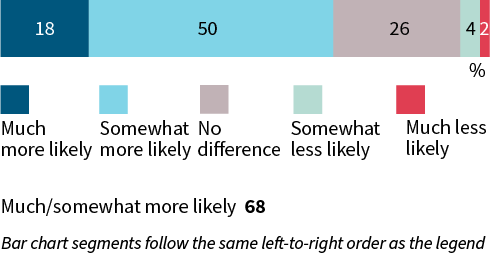
TRA3. If you felt more confident that your personal information was handled fairly and responsibly, how likely would you be to use digital services or programs that require you to share personal information?
Base: All Australians aged 18+. (n=1,504)
Notes: Don’t know (1%) and refused (0%) not displayed.