-
On this page
Part 1: Executive Summary
1.1 This report outlines the findings of the Office of the Australian Information Commissioner’s (OAIC) privacy assessment of Services Australia in its capacity as the accredited Digital ID Exchange (Exchange) for the Australian Government’s Digital ID System (AGDIS). We conducted this assessment under section 33C(1)(g)(i) of the Privacy Act 1988 (Privacy Act), which permits the OAIC to assess whether personal information (within the meaning of the Digital ID Act 2024 (Digital ID Act)) is being maintained and handled in accordance with the Digital ID Act’s additional privacy safeguards and rules made for the purpose of the additional privacy safeguards.
1.2 Digital Identity (also known as Digital ID) is a voluntary way for Australians to prove their identity online and access certain Government services.
1.3 The Exchange is operated by Services Australia and is an integral part of the Australian Government Digital ID System. It acts like a switchboard, transferring information with consent between the various participants in the AGDIS, such as relying parties, identity providers and attribute service providers.
1.4 The objective of the assessment was to examine whether Services Australia—in its capacity as the accredited Exchange for the AGDIS—was collecting, using, disclosing, retaining and destroying or de-identifying personal information in accordance with the additional privacy safeguards contained in the Digital ID Act.
1.5 The scope of the assessment focused on Services Australia’s compliance with relevant provisions in Division 2 of Part 2 of Chapter 3 of the Digital ID Act ( ss 44-56 ), known as the additional privacy safeguards. In particular, the assessment considered the following additional privacy safeguards with respect to the Exchange:
- prohibition on the collection of certain attributes (i.e. information including personal information, associated with the individual verifying their identity) by the Exchange from the AGDIS’s identity provider myID (operated by the Australian Taxation Office or ATO) and relying parties ( s 44 );
- express consent required for disclosure of certain attributes of individuals to relying parties ( s 45 );
- disclosure of only certain information by the Exchange to relying parties and the prohibition on the disclosure of restricted attributes and unique identifiers unless it is for a purpose set out in ss 46-47 , such as to investigate a fraud or cyber security incident;
- information disclosed to relying parties cannot be used by the Exchange as part of data profiling to track online behaviour ( s 53 ). The assessment also considered the Exchange’s ‘double blind model’ where the Exchange conceals from the identity provider (myID) which relying party services users are accessing with their Digital ID and vice versa; and
- attributes collected by the Exchange are destroyed or de-identified at the conclusion of each transaction ( s 56 )
The OAIC also considered relevant rules made under the Digital ID Act, including the Digital ID (Accreditation) Rules 2024 (the Rules) and the Digital ID (Accreditation) Data Standards 2024 (the Standards).
1.6 When assessing compliance with the above provisions, the OAIC considered whether Services Australia had policies, procedures, systems and controls that enabled it to effectively comply with the Digital ID Act and uphold the additional privacy safeguards in relation to personal information handled by the Exchange.
1.7 We identified one high privacy risk : Exchange-specific staff training was not mandatory for relevant Services Australia staff. To address this risk, we made onerecommendation :
- as required under rule 4.44, Services Australia must ensure all relevant staff complete Exchange-specific privacy awareness training prior to working on the Exchange.
- The training must also be refreshed at least once every 12 months.
- To ensure completion of this training, the OAIC recommends Services Australia should keep a record of staff who work on the Exchange as part of their duties and regularly check against who has completed the training.
The recommendation should be implemented within 2 months of this report’s publication.
1.8 The OAIC also identified 2 low privacy risks where Services Australia could apply good privacy practice, specifically regarding the drafting of the Exchange’s internal policies and external facing documents. To address these risks, the OAIC made 2 suggestions :
- Services Australia could be consistent in relation to how it reports the timeframe concerning the destruction of attributes by the Exchange across all the Exchange’s internal policies and external facing documents.
- Services Australia could create and implement a data-retention policy which governs all the information generated and held by the Exchange (core attributes, restricted and technical attributes, identifiers, metadata, log data, and records related to the investigation of data breaches) and considers the operational, legal, and regulatory needs for retaining the data. The policy could also set out the timeframes for keeping various types of information generated and held by the Exchange, including what types of data are retained after every transaction and for how long. This policy could take the form of the logging implementation and monitoring plan recommended by the Exchange’s 2024 Trusted Digital Identity Framework (TDIF) Privacy Assessment[1] and required under the Rules or as part of ongoing work that is undertaken by Services Australia to review its records disposal authorities.
Part 2: Introduction
2.1 The Digital ID Act commenced on 1 December 2024 and replaced the former TDIF scheme, a voluntary accreditation framework for providing digital identity services. The Digital ID Act:
- sets out the principles, governance and oversight mechanisms for the regulation of entities providing or relying on Digital ID services; and
- establishes the legislated accreditation scheme for Digital ID providers and the AGDIS.
2.2 Digital ID is a voluntary, secure electronic way for Australians to prove their identity online and access a range of Government services without physical documents or repeatedly sharing information. Australia’s Digital ID system has 2 components: (i) the voluntary Digital ID Accreditation Scheme for Digital ID service providers (discussed in the ‘Digital ID Act’ section below); and (ii) the AGDIS.
The accreditation scheme and additional privacy safeguards
2.3 Under the Digital ID Act, entities (government or private sector) seeking to provide Digital ID services within the AGDIS must be accredited by the Digital ID Regulator, the Australian Competition and Consumer Commissioner (the ACCC).
2.4 Accredited entities must conduct mandatory annual reviews and submit annual reports to the Digital ID Regulator. These reviews include a self-assessment of the accredited entity’s compliance with the Digital ID legislation’s privacy requirements. The purpose of an annual review is to satisfy the Digital ID Regulator that the accredited entity continues to meet its obligations under the Digital ID legislation.
2.5 When providing accredited services, accredited entities must comply with the 13 additional privacy safeguards contained in ss 46-56 of the Digital ID Act. These safeguards are in addition to, and build on, the Australian Privacy Principles (APPs) contained in the Privacy Act or equivalent state or territory laws. [2] The 13 additional privacy safeguards:
- regulate accredited entities’ handling of biometric information and certain attributes when providing accredited services
- outline requirements to obtain express consent for the handling of biometric information and certain other attributes of individuals; and
- limit the handling of personal information for data profiling, enforcement purposes and marketing.
The AGDIS
2.6 The AGDIS is the system which allows individuals to verify their identity online using myID as their Digital ID. MyID, administered by the ATO, is the Australian Government’s Digital ID provider and the sole accredited identity provider for the AGDIS at the time of the assessment. MyID allows users to verify their identity and access various Commonwealth, state and territory services like myGov, Centrelink, and ATO services.
2.7 To participate in the AGDIS, entities need to be accredited. In addition to the additional privacy safeguards, accredited entities must comply with requirements set out in the Digital ID Act and in a number of legislative instruments, including rules and data standards outlined in the Rules and the Standards.
2.8 Services Australia has several roles in the AGDIS. It is an accredited identity exchange provider for the AGDIS (the only one at the time of writing). In addition to its role as the Exchange, Services Australia has separate roles within the AGDIS as a relying party (such as Centrelink, myGov) and as an attribute provider. The Office of the System Administrator (OSA), which is responsible for managing the day-to-day operation of the AGDIS is also located within Services Australia.
2.9 The AGDIS will expand to include state and territory government agencies as accredited providers and eventually include private sector services. This will provide a national, phased approach to digital identity verification. By December 2026, private businesses will also be able to apply to join the AGDIS.
The Digital ID Exchange
2.10 The Exchange is a key component of, and acts as a central hub for, the AGDIS, allowing users to use their Digital ID to interact with a growing number of online services without sharing sensitive identity documents directly. It manages and coordinates the secure flow of identity information between parties participating in the AGDIS for the purpose of identity verification. Specifically, it connects information between an entity verifying the identity of an individual (known as a relying party) in order to access the relying party’s services, and an accredited identity provider (currently only myID) which helps individuals set up and manage a Digital ID.
2.11 An individual will begin their journey typically in an unauthenticated session with a relying party. The user will indicate they want to authenticate their identity using the myID Digital ID to access a particular relying party’s service. The relying party will then contact the Exchange requesting the relevant identity information they need to authenticate the individual. The individual is then transferred to myID’s environment, where they sign into and authorise the identity provider to send the information requested to the Exchange.
2.12 The user is then returned to the Exchange where the user reviews the data to be disclosed and consents to the disclosure of that data with the requesting relying party.
2.13 Once the Exchange receives consent, the information is then disclosed to the relying party, allowing the user to engage the relying party’s service. This entire process is referred to as a transaction.
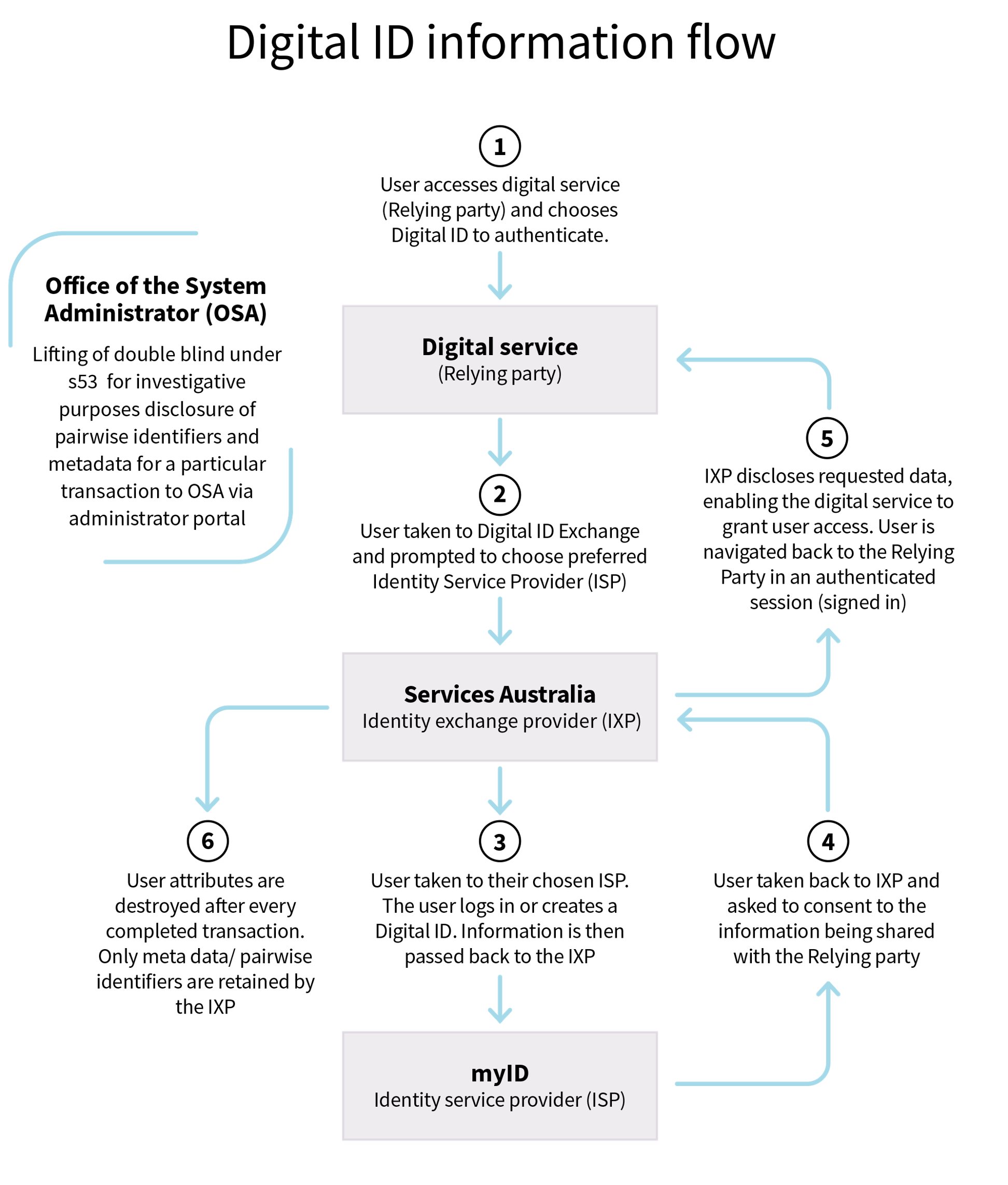
2.14 The Exchange collects, generates, uses, discloses and retains attributes for the purpose of identity verification.[3] The Exchange can handle:
- core attributes including the individual’s first and last name, date of birth and in some instances email address and phone number
- for limited transactions where the Digital ID Regulator has allowed it, restricted attributes including details (data fields) contained in government-issued verified identity documents, for example, government identifiers contained in passports, birth certificates, Medicare cards or driver’s licences
- unique identifiers, in the form of a series of letters and numbers generated by the Exchange and assigned to relying parties (known as the RP link ID) and the identity provider (known as the IDP link ID) which are contained within every transaction processed by the Exchange and the linking of these identifiers (known as ‘pairwise identifiers’). These identifiers are also referred to as ‘transaction audit identifiers’ as they enable auditing of transactions if needed to investigate fraud or cyber security incidents. Part 3 below discusses unique identifiers in more detail in the context of ss 47 and 53.
- technical attributes that describe the type of transaction that occurred such as relying party requesting verification of a digital ID, identity provider verifying a digital ID, the identity proofing level the individual user’s Digital ID are verified at and the authentication level it is using. They can also be system-generated alphanumerical reference numbers unique to a particular individual, which are not meaningfully identifiable but assigned to individuals and used by the Exchange to identify the user and the user’s account. An example of this is the myGov LinkID attribute which links an individual to their myGov account.
2.15 Services Australia advised that metadata, in the form of event log information containing dates and timestamps about each identity transaction, is also generated and handled by the Exchange.
2.16 Services Australia advised that, if hypothetically, an identity provider attempted to incorrectly send information to the Exchange which did not align with the types of attributes set out in the Standards and the Rules, the Exchange would not be able to read or interpret that data. The Exchange can only deal with attributes it has been programmed to recognise and therefore would not form part of the information sent to the relying party.
2.17 Even though some government services require biometric information to set up stronger digital IDs, Services Australia advised that the Exchange does not handle biometric information. Any handling of biometric information is undertaken by the AGDIS identity provider myID.
2.18 The Exchange presently operates using a ‘double blind’ model. The double blind is a technical measure where the Exchange prevents the identity provider from knowing which relying party is requesting verification of the personal information about an individual. The relying party in turn also does not know which identity provider the individual is using. The ‘double-blind’ is covered in more detail in Part 3 of the report, specifically where we discuss ss 47 and 53.
2.19 Information handled by the Exchange is also subject to destruction and retention processes. These issues are discussed in more detail in Part 3 of the report.
The OAIC’s role and previous digital identity assessments
2.20 The OAIC is the privacy regulator of Digital ID. We are responsible for ensuring individuals’ privacy is protected by overseeing compliance with the privacy safeguards that apply to all accredited entities. This includes conducting assessments of accredited Digital ID entities. [4]
2.21 We conducted this assessment under section 33C(1)(g)(i) of the Privacy Act, which permits the OAIC to assess whether personal information (within the meaning of the Digital ID Act) is being maintained and handled in accordance with the Digital ID Act’s additional privacy safeguards and rules made for the purpose of the additional privacy safeguards.
2.22 The OAIC’s previous Digital ID assessments have included:
- whether Services Australia, in its capacity as the operator of the Identity Exchange for the Digital ID, was handling personal information in accordance with APP 1.2. This assessment is available here.
- whether the ATO and its third-party vendor (iProov) were taking reasonable steps under APP 11.2 to destroy, or de-identify biometric information handled as part of myID. This assessment is available here.
- whether the ATO, as operator of myID, were complying with requirements under APPs 1.3 and 1.4 (regarding a clearly expressed and up to date privacy policy), APP 5 (regarding notification of collection of personal information) and APP 6 (regarding the use or disclosure of personal information). This assessment can be found here.
- whether 3 Gateway Service Providers were complying with requirements under APPs 1.2 and 1.4 (regarding a clearly expressed and up to date privacy policy in relation to their role as a Gateway Service Provider in the Document Verification Service. This assessment can be found here.
- whether the ATO, as operator of the myID and the Relationship Authorisation Manager (RAM), were complying with requirements for handling requests by enforcement agencies for personal and biometric information collected by myID and personal information collected by RAM. This assessment can be found here.
Part 3: Observations, findings and recommendations
About this assessment
3.1 This assessment considered whether Services Australia had policies, practices, procedures and systems in place to enable it to comply with the Digital ID Act. This involved reviewing documents and interviewing Services Australia staff. During these interviews, Services Australia described how the Exchange handled personal information and measures taken to ensure compliance with the safeguards.
3.2 Services Australia provided the OAIC with a suite of internal policies and other documents related to the Exchange which describe its operation, related risks and set out processes and procedures for handling personal information (such as disclosures to the OSA). Key documents included:
- the Exchange’s 2024 TDIF Privacy Assessment
- Digital Identity Exchange Accountabilities document
- the Digital ID Exchange Fraud and Corruption Risk Management Plan (FCRMP)
- ADGIS System Administrator Operational Handbook
- Service’s Australia’s Privacy Incident and Data Breach Response Plan (with a schedule specifically on the Exchange).
3.3 The Exchange’s 2024 TDIF Privacy Assessment was conducted by the Australian Government Solicitor (AGS) as part of its annual privacy assessment with Services Australia on the Digital ID Exchange, as a requirement to maintain TDIF accreditation for the Exchange against the former TDIF scheme. The provisions within the former TDIF scheme mirror the key elements of the provisions within the Digital ID Act, and the OAIC is satisfied with the AGS’s findings and recommendations. To clarify, the TDIF Privacy Assessment was not a privacy assessment under s 33C of the Privacy Act.
3.4 At the time of fieldwork, Services Australia had not yet undertaken its first annual review under the Digital ID legislation.
3.5 Services Australia advised it was gradually updating the Exchange’s documentation to reflect and comply with the Digital ID Act requirements, which would be complete by the time of their next annual review by the Digital ID Regulator (which was due in April 2026). The Digital ID Regulator agreed to this transition period in light of the new privacy, security and usability standards for providers contained in the Digital ID Act. The OAIC took this transition period into account when considering the Exchange’s compliance with the Digital ID Act.
3.6 The scope of this assessment was Services Australia’s compliance with safeguards found in ss 44-47, 53 and 56 of the Digital ID Act, based on their relevance to the Exchange. We examine compliance with each of these sections of the Digital ID Act below.
Section 44: Prohibition on collection of certain attributes
3.7 Section 44 of the Digital ID Act prohibits an accredited entity collecting information about an individual’s racial or ethnic origin, political opinions, membership of a political association, religious beliefs or affiliations, philosophical beliefs, or sexual orientation or practices.
3.8 This prohibition does not apply if the accredited entity did not solicit the attribute of the individual, and destroys the attribute, as soon as practicable, after becoming aware they have collected the attribute.
Observation
3.9 Services Australia advised that the Exchange does not handle attributes prohibited under s 44, as the Exchange is programmed to not send or receive them. Services Australia said that the Exchange adopts the data minimisation principle by only collecting attributes permitted under the Standards.
3.10 Services Australia stated that the Exchange had built-in, technical features that controlled the flows of information and prevented collecting and disclosing personal information not permitted under the privacy safeguards, including if that information was unsolicited.
3.11 Services Australia’s statement was supported by internal policies and procedures, risk assessments, and other material such as the 2024 TDIF Privacy Assessment Report, the AGDIS System Administrator Operational Handbook, and staff training material concerning the Exchange.[5] Services Australia also provided the OAIC with the Digital ID Exchange Accountabilities document. This internal policy document was an indicator of compliance with s 44 as it contained information regarding the operation of the Exchange and linked these practices to the compliance with obligations in s 44.
3.12 Public facing information and documents, such as the Exchange’s privacy policy,[6] the user journey process and privacy notice, do not refer to any of the prohibited attributes as being types of information collected, used or disclosed by Services Australia.
Finding
3.13 Based on the documents provided to the OAIC and evidence provided by Services Australia staff in interviews during fieldwork, the OAIC did not identify any non-compliance with s 44 of the Digital ID Act.
Section 45: Express consent for disclosure of certain attributes to relying parties
3.14 Section 45 requires that when verifying the identity of an individual or authenticating a Digital ID of, or information about, an individual to a relying party, the accredited entity must obtain the individual’s express consent[7] before disclosing a user’s name, address, date of birth, phone number, email address (core attributes) or an attribute as prescribed by the Rules.[8]
Observation
3.15 Services Australia advised that the Exchange had built-in, technical features that meant the flow of information depended on a user’s express consent before the user’s attributes were disclosed to relying parties. This was supported by internal documentation, such as the 2024 TDIF Privacy Assessment, the Digital ID Act privacy training material, the Digital Identity Exchange Accountabilities and the AGDIS System Administrator Operational Handbook, and records of consent logs.
3.16 Services Australia provided screenshots of users’ online experience. The screenshots showed that the Exchange prompted users with clearly explained options regarding their consent, including the option to have enduring consent. It provided users a summary of the information they consented to disclose, and users clicked a ‘consent button’ to complete the transaction.
3.17 The consent page linked to the Digital ID dashboard, which provided users their activity history and allowed them to manage and withdraw their consent. In accordance with the Rules, the Exchange’s ongoing consents from users automatically expired after 12 months.
3.18 The Exchange’s privacy policy, privacy collection notice, and the user journey it demonstrated, provided users with clear, relevant and timely explanations of consent.
Finding
3.19 The OAIC did not identify any privacy risks specifically in relation to s 45 of the Digital ID Act.
Section 46: Prohibition of disclosure of restricted attributes without express consent
3.20 Section 46 of the Digital ID Act states that when verifying the identity of an individual or authenticating a Digital ID of, or information about, an individual to a relying party, an accredited entity must not disclose a restricted attribute of the individual to the relying party without the express consent of the individual. In addition, accredited entities can only disclose restricted attributes to relying parties if they are authorised to do so.
Observation
3.21 Services Australia advised that the Exchange required express consent from users before sharing any restricted attributes with relying parties. It only disclosed the restricted attributes that the Digital ID Regulator had approved for the relying party in question to collect.
3.22 The same technical features which applied to s 45 also applied in relation to restricted attributes, as required under s 46. Services Australia advised that the Exchange was designed to recognise and prevent prohibited disclosures of restricted attributes. Relying parties received a 'denied access error' from the Exchange when they attempted to request disclosure of a restricted attribute, they were not authorised to request.
3.23 The Exchange’s internal documents, such as the 2024 TDIF Privacy Assessment, identified it was compliant with former TDIF requirements that align with s 46. The privacy policy and privacy notice indicate compliance with s 46, and the user-driven consent functionality (discussed above at paragraph 3.16 regarding screenshots of users’ experience) also applied to the disclosure of restricted attributes, and therefore also reflected the requirements of s 46.
Finding
3.24 The OAIC did not identify any privacy risks specifically in relation to s 46 of the Digital ID Act.
Section 47: Restriction on disclosure of unique identifiers
3.25 Section 47 of the Digital ID Act states that an accredited entity can only disclose unique identifiers that have been assigned to individuals by accredited entities within the Digital ID system, to relying parties and other accredited entities.
3.26 Subsection 47(4) states that the disclosure restrictions do not apply in relation to specified purposes, such as detecting, managing and investigating ID fraud incidents and cyber security incidents within the AGDIS system; and detecting, reporting, investigating or prosecuting an offence against a Commonwealth, State or Territory law.
Observation
3.27 Services Australia advised that the Exchange handled unique identifiers contained within every transaction processed by the Exchange, specifically the RP link ID[9] and the IDP link ID. [10]
3.28 Services Australia stated that when the relying party requested information from the identity provider, the Exchange linked them together and would be able to see what service the individual tried to access (from the relying party) and that myID provided the identity information to complete the transaction.
3.29 The resulting information linking these 2 identifiers was known as a ‘pairwise identifier’ and was a record of the pairing. However, pairwise identifiers were not shared across the AGDIS. The pairwise identifiers – technical attributes that describe the type of transaction that occurred and transaction metadata – were the only data the Exchange retained on a long-term basis after each transaction (see s 56 below).
3.30 The Exchange only disclosed unique identifiers with the entity to which the identifier related (i.e. the RP link ID with the relying party and the IDP link ID with the identity provider). This meant a relying party was not able to identify which identity provider provided the identity information, and an identity provider was not able to identify which relying party relied on the identity information. It formed the basis of the Exchange’s ‘double blind’ (see s 53 below).
3.31 However, the Exchange could ‘lift the double blind’ and disclose the pairwise identifiers to the OSA for investigation purposes set out in s 47. Services Australia advised that the Exchange only disclosed the pairwise identifiers, transaction type and the date and time of the transaction to the OSA, which would then consider them as part of its investigation into a particular matter.
Finding
3.32 Services Australia provided documents demonstrating it has policies and procedures in place governing the handling of unique identifiers including the disclosure of unique identifiers for purposes outlined in s 47(4)(a)-(e). In particular, the AGDIS System Administrator Operational Handbook set out in detail the processes and procedures that needed to be followed.
3.33 The Digital ID Exchange Accountabilities document, while requiring updates to reflect the introduction of the Digital ID Act, provided clear descriptions and explanations of the use of the unique identifiers. These were aligned with s 47. The document provided an overview of the processes in place for the Exchange’s response to investigative processes, including lifting the double blind, and directing staff to guidance material on when and how to disclose information to the Interim Oversight Authority (now the OSA). The Fraud and Corruption Risk Management Plan outlined the process in which fraud investigations took place including lifting the double blind. The Exchange privacy training outlined the requirements of s 47.
3.34 The Exchange’s privacy policy and privacy notice also supported compliance with s 47 with users informed that their personal information may be used or disclosed to detect, manage and investigate Digital ID fraud incidents.
3.35 The OAIC did not identify any risks to compliance with s 47 of the Digital ID Act.
Section 53: Prohibition on data profiling to track online behaviour
3.36 Section 53 of the Digital ID Act prohibits data profiling by accredited entities to track online behaviour. In particular, an accredited entity must not use or disclose personal information, including metadata,[11] it holds about an individual, which it gathered from the user’s interaction with the Digital ID. Section 53 applies even if the individual has consented to the use or disclosure. The prohibition in s 53 does not apply where the use or disclosure is:
- required or authorised by or under a law; or
- for the purposes of the accredited entity complying with the Digital ID Act; or
- for purposes relating to improving the performance or useability of the entity’s information technology system used to provide its accredited services (and not broader business purposes).
Observation
3.37 Services Australia informed the OAIC that the Exchange did not collect, use or disclose any behavioural information or analytics (including data on the services an individual had accessed or tried to access). Services Australia advised during fieldwork that the Exchange’s technical features controlling the flows of information prevented the Exchange from collecting behavioural information from AGDIS participants and prevented the Exchange, accredited entities and relying parties from undertaking any data profiling or online behaviour tracking of individuals. This meant Digital ID transactions routed through the Exchange could not be combined or correlated across different services or transactions.
3.38 Services Australia advised the Exchange transmitted to relying parties’ identity attributes encrypted <Redacted> . <Redacted> , further preventing any potential tracking or behaviour profiling over time. A limited number of administrators within Services Australia could access the identity attributes <Redacted> (if needed to address any technical concerns which may have arisen). This access was closely monitored and logged.
3.39 Services Australia further advised that it directly managed the Exchange and all supporting IT systems, with no external providers involved. By directly operating the Exchange and limiting external access to transactional data, the architecture reduced the risk that information about an individual’s service use could be aggregated or used for cross-service behavioural profiling.
3.40 The double-blind technical measure was designed to prevent user profiling, by obfuscating which entities were involved during verification of a user’s Digital Identity. Specifically, the identity provider was responsible for verifying the individual’s identity but did not know what service (relying party) the user was interacting with. Conversely, the relying party had no ability to identify the user’s identity provider. This measure protected the individual by reducing the amount of personal information being transferred and ensuring no data profiling or online tracking of individuals by either relying party or identity provider could occur. As noted in the discussion regarding s 47 above, the Exchange could lift the double blind when it disclosed information to the OSA for specific purposes such as for investigating cyber incidents and fraud.
Finding
3.41 Technical measures <Redacted> ensured the Exchange only routed information that was required for identity authentication, without reviewing or analysing any personal information and the internal management of the Exchange by Services Australia prevented data profiling and online tracking of behaviour.
3.42 In addition to the abovementioned technical measures, the application of the double blind also ensured compliance with s 53 of the Digital ID Act and the data minimisation principles under rule 4.42 of the Rules, ensuring that only the essential data needed for the service access was processed within the Exchange. This was corroborated by the 2024 TDIF Privacy Assessment which confirmed that Services Australia was compliant with TDIF requirements mirroring s 53.
3.43 Based on the information provided, the OAIC did not identify any risks to compliance with s 53 of the Digital ID Act.
Section 56: Prohibition on the retention of certain attributes by an accredited identity exchange provider
3.44 Section 56 states that if an accredited identity exchange provider receives the name, address, date of birth, phone number, email address, a restricted attribute or attributes of a kind prescribed in the Rules, of individuals collected during an authentication session, the exchange provider must not retain that information after the session.[12]
Observation
3.45 Services Australia informed the OAIC that, <Redacted> , the Exchange destroyed identifying attributes covered by s 56. The Exchange’s event logs only retained the pairwise identifiers, technical attributes (transaction type data) and transaction metadata (the date and time stamps) for each transaction.
3.46 The 2024 TDIF Privacy Assessment found Services Australia compliant in relation to not retaining users’ attributes or restricted attributes once they are passed from an identity service provider to a relying party. <Redacted> .
3.47 Services Australia informed the OAIC there was regular testing to make sure the Exchange destroyed attributes after each transaction to ensure compliance with s 56.
3.48 The OAIC was advised that the retention of the event logs, as identified in the 2024 TDIF Privacy Assessment, remained a non-compliance issue. The 2024 TDIF Privacy Assessment identified that the indefinite and ongoing retention of the event log information posed a privacy and security risk as they were required to be destroyed in accordance with appropriate record disposal authorities. Services Australia advised there was work underway to create and implement a logging implementation and monitoring plan (as required under rule 4.20 of the Rules) to address this non-compliance issue. We were advised at the time of undertaking fieldwork in this assessment that this proposed plan was scheduled to be implemented by 30th November 2025.
3.49 In addition, the Exchange had established and implemented destruction timeframes for some of the logging and monitoring records, but for others was in the process of determining the required retention period. For example, the logs of the pairwise identifier was required to be retained for 3 years under the rule 4.20. However, Services Australia informed the OAIC they had sought legal advice regarding the retention period obligations under the Archives Act 1983 (Cth), which is 7 years.
3.50 The Exchange, as an accredited entity, must also comply with record-keeping requirements in rule 4.46 and retain records related to the Exchange’s investigation of and response to data breaches. The OAIC was not provided with a retention policy governing these records, and it was unclear how Services Australia was meeting this requirement.
3.51 The OAIC observed inconsistent references to destruction timeframes. The Exchange privacy policy referred to a <Redacted> but the Exchange’s FCRMP referred to <Redacted> of destruction. Services Australia advised this difference reflected different methodologies around when the timeframe commenced: <Redacted> . However, these different methodologies were not explained in the documents.
Finding
Retention policy
3.52 Services Australia confirmed the Exchange destroyed identifying attributes (i.e. personal information) covered by s 56 after each transaction and that these attributes were not retained in Exchange event logs after each completed transaction. Therefore, the OAIC did not identify any compliance issue with s 56.
3.53 The lack of data-retention policy that governs all the information generated and held by the Exchange raises a low privacy risk that Services Australia may be unnecessarily retaining information not covered by s 56. It also raises a low privacy risk that Services Australia may not be meeting requirements under rules 4.46 (mentioned above), which is to some extent complementary to obligations under s 56.
3.54 The OAIC suggests Services Australia create and implement a data-retention policy which governs all the information generated and held by the Exchange (core attributes, restricted and technical attributes, identifiers, metadata, log data, and records related to the investigation of data breaches) and considers the operational, legal, and regulatory needs for retaining the data.The policy could also set out the timeframes for keeping various types of information generated and held by the Exchange, including what types of data are retained after every transaction and for how long. This policy could take the form of the logging implementation and monitoring plan recommended by the Exchange’s 2024 TDIF Privacy Assessment and as required under the Rules or as part of ongoing work that is undertaken by Services Australia to review its records disposal authorities
3.55 While out of scope of this assessment, Services Australia may also wish to consider whether the indefinite and ongoing retention of the event log information raises a risk of non-compliance with s 136 of the Digital ID Act (destruction and de-identification of information by AGDIS participants).[13]
Suggestion 1
The OAIC suggests Services Australia create and implement a data-retention policy which governs all the information generated and held by the Exchange (core attributes, restricted and technical attributes, identifiers, metadata, log data, and records related to the investigation of data breaches) and considers the operational, legal, and regulatory needs for retaining the data.
The policy could also set out the timeframes for keeping various types of information generated and held by the Exchange, including what types of data are retained after every transaction and for how long.
This policy could take the form of the logging implementation and monitoring plan recommend by the Exchange’s 2024 TDIF Privacy Assessment and as required under the Digital ID (Accreditation) Rules 2024 or as part of ongoing work that is undertaken by Services Australia to review its records disposal authorities.
Finding
Destruction timeframe
3.56 There is a low privacy risk that inconsistent messaging regarding core attribute destruction timeframes may create confusion as to how the Exchange is complying with the additional privacy safeguards, in particular s 56.
3.57 The OAIC suggests Services Australia could be consistent with its documentation in relation to how it reports the timeframe concerning the destruction of attributes across all internal and external documentation related to the Exchange. A data-retention policy (see suggestion 1) could also assist in clarifying destruction timeframes.
Suggestion 2
The OAIC suggests Services Australia could be consistent in relation to how it reports the timeframe concerning the destruction of attributes by the Exchange across all the Exchange’s internal policies and external facing documents.
Rule 4.44: Privacy awareness training
3.58 Under rule 4.44 of the Rules, accredited entities must ensure that all staff who work on the Exchange complete privacy awareness training in relation to their obligations under the Digital ID Act. Such training is necessary to support ongoing compliance with the additional privacy safeguards, by ensuring staff understand how personal information within the AGDIS must be collected, used, disclosed and protected in accordance with the legislative obligations.
Observation
3.59 Services Australia advised that Exchange-specific privacy training is available to relevant staff, covering privacy and safeguard obligations under the Digital ID Act. The training sufficiently explains the additional privacy safeguards, enabling staff to understand the legislative requirements, and how the Exchange should be operating within this context. However, unlike mandatory general privacy training undertaken by all Services Australia staff annually, this Exchange-specific training was not mandatory.
Finding
3.60 While staff training is not specifically mentioned in the additional privacy safeguards, it is a measure which assists with compliance with legislative obligations. However, training is a requirement under the Rules, specifically Rule 4.44. Rule 4.44 states an accredited entity must ensure that each of its personnel whose duties relate to its accredited services or Digital ID data environment complete privacy awareness training. The training must cover the entity’s privacy policy, privacy management plan and compliance with the additional privacy safeguards in Chapter 3 of the Digital ID Act and Part 4.3 of the Rules. Personnel must complete training before starting work on those duties; and at least once in every 12-month period thereafter.
3.61 Under Rule 4.44, training must be completed by staff whose duties relate to the Exchange; before starting work on those duties and then at least once every 12-months thereafter.
3.62 Exchange-related privacy awareness training is not mandatory for staff whose duties relate to it, raising the high privacy risk that Services Australia is not complying with the Rules, and relevant staff are not aware of the additional privacy safeguards. We note this risk at the time of fieldwork is somewhat mitigated due to:
- the experience and expertise of staff currently working on the Exchange; fieldwork interviews demonstrated a sound understanding of the technical aspects of the Exchange functionality, and the additional privacy safeguard requirements
- Digital ID-Exchange specific training already was in place under the former TDIF and was updated to reflect the Digital ID Act’s additional privacy safeguards. The updated training included explanations of the Digital ID safeguards and the Exchange’s governance documentation, including data breach reporting requirements and processes.
3.63 To address the high privacy risk of Services Australia not meeting its obligation under rule 4.44, with the potential consequence of staff being insufficiently aware of the requirements of the Digital ID Act’s legislative requirements, the OAIC makes the following recommendation:
Recommendation 1
The OAIC recommends that, as required under rule 4.44 of the Digital ID (Accreditation) Rules 2024, Services Australia must ensure all relevant staff complete Exchange-specific privacy awareness training prior to working on the Exchange.
- The training must also be refreshed at least every 12 months.
- To ensure completion of this training, the OAIC recommends Services Australia should keep a record of staff who work on the Exchange as part of their duties and regularly check against who has completed the training.
Timeframe: Within 2 months of this report’s publication.
Part 4: Summary of recommendations and responses
Recommendation 1
The OAIC recommends that, as required under rule 4.44 of the Digital ID (Accreditation) Rules 2024, Services Australia must ensure all relevant staff complete Exchange-specific privacy awareness training prior to working on the Exchange.
- The training must also be refreshed at least every 12 months.
- To ensure completion of this training, the OAIC recommends Services Australia should keep a record of staff who work on the Exchange as part of their duties and regularly check against who has completed the training.
Timeframe: Within 2 months of this report’s publication.
Services Australia’s response:
4.1 Services Australia (the Agency) acknowledges the OAIC’s findings and suggestions for remediation and is committed to ensuring clear, consistent, and accurate articulation of attribute destruction timeframes across all internal policies and external-facing documentation the Digital ID Exchange (IDX). The Agency recognises that consistency in this area is critical to transparency, regulatory confidence, and sustained trust in handling of personal and identity-related information within the Australian Digital ID System (AGDIS).
4.2 The Agency can confirm that it has taken substantive action to address this suggestion and main recommendation. In November 2025, the Agency developed and endorsed a Logging Implementation and Monitoring Plan (the Plan) which establishes a robust, secure, and compliant approach to logging practices for the IDX. The Plan was developed in direct alignment with Rule 4.20 of the Digital ID (Accreditation) Rules 2024 and addresses new legislative requirements that were not previously prescribed under the TDIF, ensuring a contemporary and future-focused control environment.
4.3 In accordance with Rule 4.20(7) of the Digital ID (Accreditation) Rules 2024, the Plan outlines how the IDX logs are retained, archived, and ultimately destroyed in line with the Archives Act 1983 and broader Digital ID legislative framework. It defines a minimum retention period, archiving arrangements, and deletion timeframes, and describes the automated batch processes support the routine privatisation and deletion of sensitive authentication and identity-related data. The Plan also recognises upcoming seven-year log deletion requirements and confirms these will be embedded into ongoing design and delivery arrangements to ensure continued compliance and consistency as legislative obligations mature.
4.4 Beyond technical controls, the Agency has reinforced its governance and cultural capability to support compliant data handling. In February 2026, the Agency completed a formal report confirming compliance with the Digital ID Act 2024 privacy training requirements for staff supporting the IDX and myGov LinkID accredited services. This work provides assurance that personnel involved in the Digital ID ecosystem are appropriately equipped to understand and apply privacy and data lifecycle obligations, including those relating to retention and destruction.
4.5 Consistent with Rule 4.44 of the Digital ID (Accreditation) Rules 2024, the Agency has mandated that all personnel whose duties relate to accredited services or the Digital ID data environment must complete privacy awareness training before commencing their duties and at least every 12 months thereafter. Ongoing assurance is provided through the generation of an annual compliance report, which monitors completion rates and supports alignment with any updates to Privacy Rules made under the Digital ID Act 2024.
4.6 To support this requirement, the Digital ID Act 2024 Privacy Awareness Training package has been developed and delivered specifically for the Digital ID program. The training provides targeted instruction on Digital ID-specific privacy obligations, statutory safeguards, consent-handling requirements, and accreditation responsibilities, reinforcing a consistent understanding of data handling practices across technical, operational, and policy domains.
4.7 Collectively, these measures demonstrate that the Agency has not only addressed the OAIC’s suggestions and recommendations, but has embedded the intended outcomes through formalised controls, governance mechanisms, and workforce capability. This integrated approach ensures that attribute destruction timeframes are consistently defined, communicated, and applied across the Digital ID ecosystem, strengthening regulatory assurance and supporting the secure and trusted operation of the IDX.
Part 5: Description of assessment
Objective and Scope
5.1 The objective of the assessment was to examine whether Services Australia, in its capacity as the accredited Exchange for the AGDIS, was collecting, using, disclosing, retaining and destroying or de-identifying personal information in accordance with the additional privacy safeguards contained in the Digital ID Act.
5.2 The scope of the assessment focused on Services Australia’s compliance with relevant provisions in Division 2 of Part 2 of Chapter 3 of the Digital ID Act, known as the additional privacy safeguards. In particular, the assessment considered the following additional safeguards:
- collection of personal attributes by the Exchange from the AGDIS’s identity provider myID (operated by the Australian Taxation Office or ATO) and relying parties ( s 44 )
- how Services Australia seeks express consent for the Exchange to disclose certain attributes of individuals to relying parties ( s 45 )
- disclosure of only certain information by the Exchange to relying parties and restricted attributes or unique identifiers are not disclosed, unless it is for a purpose set out in ( ss46-47 ), such as to investigate a fraud or cyber security incident
- information disclosed to relying parties cannot be used by the Exchange as part of data profiling to track online behaviour ( s 53 ). This also involved consideration of the Exchange’s ‘double blind model’ where the Exchange conceals from the identity provider (myID) which relying party services users are accessing with their Digital ID and vice versa
- attributes collected by the Exchange are destroyed or de-identified at the conclusion of each transaction ( s 56 ).
5.3 The OAIC also considered relevant rules made under the Digital ID Act, including the Digital ID (Accreditation) Rules 2024.
5.4 The assessment’s scope did not include:
- additional privacy safeguards not applicable to the Exchange or considered in previous OAIC assessments including:
- sections 48-52 of the Digital ID Act which govern the collection, use, disclosure and destruction of biometric information – these sections are not relevant to the Exchange as the Exchange does not collect, use or disclose biometric information
- section 54 of the Digital ID Act which requires that accredited entities must only use or disclose personal information to an enforcement body in specific circumstances – this provision was considered in a recent OAIC assessment
- section 55 of the Digital ID Act 2024 which requires that accredited entities must not use or disclose personal information for marketing purposes – the Exchange does not use or disclose personal information for marketing purposes.
- a physical review and testing of the technical controls and capabilities of the ICT systems used by the Services Australia to operate or support the Exchange
- consideration of other roles and responsibilities performed by Services Australia in relation to the AGDIS including as the Office of the System Administrator and as an attribute provider
- handling of personal information by other AGDIS participants.
Criteria
5.5 In addition to the requirements of the selected additional privacy safeguards and rules discussed above, the OAIC applied guidance as the assessment criteria in developing its findings and recommendations. Specifically, ‘Privacy materials for accredited entities’ guidance accessible at https://www.digitalidsystem.gov.au/digital-id-accreditation/privacy-materials-for-accredited-entities - external site. This material is owned and prepared by the OAIC as the Digital ID privacy regulator under the Digital ID Act. The materials outline the privacy rules and responsibilities all accredited entities need to follow to maintain accreditation.
Privacy risks
5.6 Where the OAIC identified privacy risks and considered those risks to be high or medium risks, the OAIC has made recommendations to Services Australia about how to address those risks. Where we find low privacy risks, we have made suggestions (see Appendix A).
5.7 For more information about privacy risk ratings, refer to the OAIC’s ‘Risk based assessments – privacy risk guidance’. Chapter 9 of the OAIC’s Guide to privacy regulatory action provides further detail on this approach.
Conduct of the assessment
5.8 The OAIC conducted this risk-based assessment of Services Australia in its role as the operator of the Exchange under s 33C(1)(g) of the Privacy Act 1988 (the Act).
5.9 The Act provides the Information Commissioner with the power to assess whether personal information is being maintained and handled in accordance with Division 2 of Part 2 of Chapter 3 of the Digital ID Act 2024 (Digital ID Act), including rules made for the purposes of that Division. in accordance with ss 49(3) and 54 of the Digital ID Act.
5.10 The assessment involved the following:
- review of relevant documents provided by Services Australia
- fieldwork, which included virtual interviews of key staff members through videoconferencing platforms on 19 August 2025.
Reporting
5.11 The OAIC generally publishes final assessment reports in full, or in an abridged version, on its website. All or part of an assessment report may be withheld from publication due to statutory secrecy provisions, privacy, confidentiality, security or privilege. This report has been published with some redactions.
Assumptions and Caveats
5.12 The OAIC conducts its assessments as a ‘point in time’ assessment; that is, our observations and opinions are only applicable to the time period in which we undertook the assessment.
5.13 This report is not an endorsement of the Exchange by the OAIC, or any other Services Australia related product or service.
Part 6: Appendices
Appendix A – Privacy risk guidance
Privacy risk rating | Entity action required | Likely outcome if risk is not addressed |
|---|---|---|
High risk Entity must, as a high priority, take steps to address mandatory requirements of Privacy and related legislation | Immediate management attention is required This is an internal control or risk management issue that if not mitigated is likely to lead to the following effects |
|
Medium risk Entity should, as a medium priority, take steps to address Office expectations around requirements of Privacy and related legislation | Timely management attention is expected This is an internal control or risk management issue that may lead to the following effects |
|
Low risk Entity could, as a lower priority than for high and medium risks, take steps to better address compliance with requirements of Privacy and related legislation | Management attention is suggested This is an internal control or risk management issue, the solution to which may lead to improvement in the quality and/or efficiency of the entity or process being assessed |
|
[1] On 12 June 2024, the Australian Government Solicitor conducted its annual privacy assessment with Services Australia on the Digital Identity Exchange as a requirement to maintain TDIF accreditation for the Exchange against the former TDIF scheme.
[2] See Interaction between the Digital ID Act and the Privacy Act https://www.digitalidsystem.gov.au/digital-id-accreditation/privacy-materials-for-accredited-entities/interaction-between-the-digital-id-act-and-the-privacy-act
[3] The type of attributes handled by the Exchange are set out in Schedule 3 of the Standards and Schedules 1-4 of the Rules. The Standards are a non-disallowable legislative instrument setting out various technical requirements and process associated with the accreditation scheme. The Rules establish privacy and security standards for Digital ID service providers seeking accreditation in Australia.
[4] The OAIC’s Digital ID regulatory strategy is available at Digital ID regulatory strategy | OAIC
[5] Digital ID Act 2024 privacy training material covered the requirements of s 44 of the Digital ID Act and stated that the IDX (the Exchange) does not collect any prohibited attributes.
[6] The Exchange privacy policy can be found at: https://auth.identity.gov.au/static/policy.
[7] Rules 4.40 – 4.41 of the Rules relate to providing clear information about express consent and the duration of consent, rule 4.20 relates to logging requirements and recording consent in a transaction, and rule 7.1 which prescribes additional attributes that an accredited entity must obtain express consent for before disclosing.
[8] See rule 7.1 of the Digital ID (Accreditation) Rules, for example attributes derived from an attribute listed above (such as whether an individual is aged over 18, which is derived from the individual’s date of birth); a ‘special attribute’ of an individual (See rule 5.35 of the Digital ID (Accreditation) Rules.); an attribute that is self-asserted by the individual and not verified.
[9] The RP link ID links the Digital ID brokered by the Exchange to the service record at a Relying Party. The Exchange generates this identifier, and it is unique for each user at each Relying Party.
[10] The IDP link ID links the identity for an authenticated user at an identity provider (myID) with the Digital Identity brokered by the Exchange. This identifier is generated by the identity provider.
[11] Section 53 refers to an accredited entity not using or disclosing information about the services provided by the entity that the individual has accessed or attempted to access, information relating to how or when access was obtained or attempted to be obtained by the individual, information relating to the methods of access or attempted access by the individual. the date and the time the individual’s identity was verified.
[12] Rule 1.6 of the Rules: An authenticated session means a persistent interaction between 2 entities involved in a transaction in a digital ID system which begins with an authentication event and ends with an event that brings the authenticated session to an end.
[13] Under s 136 of the Digital ID Act, an accredited entity that holds or has held an approval to participate in AGDIS must destroy or de-identify personal information in its possession or control when: the personal information was obtained by the entity through AGDIS; the entity is not required or authorised by law (this includes the Digital ID Act and related rules but excludes any prescribed laws) to retain the information; and the personal information does not relate to any current or anticipated legal or dispute resolution proceedings to which the accredited entity is a party.