-
On this page
In 2024, new privacy laws, known as the Privacy and Other Legislation Amendment (POLA) Act 2024, ordered the development of the Children’s Online Privacy Code (the Code).
As Australia’s privacy regulator, the OAIC is responsible for creating the Code.
This new Code will help protect children's online privacy by telling many online services, like apps, games, and websites, how they need to follow special privacy rules when taking care of children's personal information online.
Child-friendly guides to the draft Code
The Code is currently a draft. Think of it just like the first version of a speech you rehearse with your parents or carers, or a practice written response you would share with your teacher for feedback at school.
We are still planning what special rules online services should have to follow, but we are showing you what we have brainstormed so far to get your feedback.
The official draft Code is a long document filled with lots of words that relate to the law.
That is why we have worked with a group of young people to help make child-friendly guides that explain the draft Code.
Check out our:
- short guide, best for primary school aged children, and
- extended (longer) guide, best for young people and parents and carers.
But everyone is welcome to check out either the short or extended guides!

Our consultation process to develop the Code
The OAIC’s approach to developing the Code is based on research, evidence and extensive consultations.
As of March 2026, we have had more than 65 individual engagements with key stakeholders from across government, international regulators, industry, academia and the community.
It is important that the Code reflects the real experiences and needs of children and their families.
That is why we continue to consult directly with children, young people, parents and carers.
We have also met with experts in child welfare, privacy and online safety.
We want to make sure that online services bound by the Code will comply with it, so we continue to seek feedback from industry stakeholders and other groups to learn how the Code will work in practice.
To ensure this broad engagement and feedback, our consultation process has taken place in phases, with ongoing engagement throughout each stage.
Past consultations
Completed: Phase 1
January to August 2025
Initial discussions with children, parents and relevant organisations focused on children's welfare. This included:
- 337 children, young people and parents/carers responded to our online worksheets in June 2025.
- We met with relevant national and international parties in this process including, but are not limited to
- international counterparts
- eSafety Commissioner
- children’s rights, wellbeing, and protection groups
- educators and frontline service workers
- out-of-home care groups
- representatives of culturally and linguistically diverse communities
- First Nations community representatives
What we heard from children, young people, parents and carers
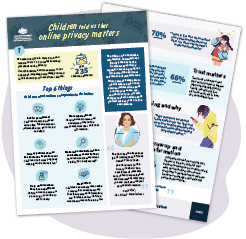 Children’s Report!
We made a report for kids about what we heard from children and young people.
In 2025, we invited children, young people, parents and carers (participants) to share their views on online privacy. Participants completed worksheets, were presented with several scenario-based exercises, and asked a series of open-ended questions. All answers provided were short response.
The top six things children and young people said that organisations should do better:
Ask for permission!
Children want to be asked more often if their personal information can be collected and used
Give more explanations!
Children want to learn and understand why online companies want their personal information
Make privacy policies short and simple!
Children don’t want lots of writing with big words. Make it fun!
Make important information and buttons easier to find!
Children want the important stuff to be clearly marked
Help children when they have questions!
Children want a person or place they can go to online to ask for help
Make it fair!
Children know that some online companies can make money from their personal information, and this feels unfair.
Access the full Children's Online Privacy Code consultation report
Completed: Phase 2
April to August 2025
Engagement with civil society, academia and industry stakeholders to gather insights and perspectives. This included:
- 167 virtual attendees to the OAIC’s public webinar about the Code in May 2025.
- 61 submissions in response to our Children’s Online Privacy Code Issues Paper.
- 70 participants in a one-day workshop (April 2025) in which digital rights and civil society representatives from academia gave feedback.
- 32 industry stakeholders, including representatives from the tech, education, gaming, retail, and telecommunications sectors, attended three industry roundtable discussions in July 2025.
Completed: Phase 3
March to June 2026
The OAIC sought feedback from children, young people, parents and carers, as well as from academic, civil society, government, industry stakeholders and other interest parties on the Exposure Draft and Explanatory Statement of the Code. This included:
- 454 virtual attendees across two dedicated webinars about the Draft Code.
- 425 submissions from children, young people, parents and carers who answered whether they like, dislike or feel neutral about the provisions in the Exposure Draft of the Code.
- 13 drawing submissions which expressed younger children’s perspectives about online privacy.
- 374 stakeholders across 14 Roundtables with representation across diverse industry sectors including gaming, education, advertising, and financial services, as well as civil society groups, academia, government and other interested parties.
- 135 unique written submissions that provided feedback on the Exposure Draft of the Code.
What we heard from civil society, academia and industry stakeholders
In 2025, the OAIC released an issues paper that invited submissions from industry, civil society organisations, academia and other interested stakeholders. The OAIC received 61 written submissions from stakeholders from a broad cross section of society. These submissions contained diverse views to issues including age assurance, consent, transparency, the best interest of the child and children’s right to permanently delete their personal information.
During the same period, the OAIC also ran three industry roundtables with 32 attendees to support detailed discussion of key issues and practical considerations of the Code. This included discussion about the alignment of the Code to other domestic and international codes and standards, clarity on the scope of services included in the Code, and a balance between principles-based and prescriptive guidance.
The OAIC also heard from 70 academic and civil society representatives during a one-day workshop. These stakeholders discussed a range of issues including greater transparency of handling children’s personal information, limiting direct marketing to children, and increasing children’s access to their personal information and ability to make corrections.
While views from industry, civil society organisations, academia and other interested stakeholders were diverse in nature, there was broad support for the Code and the goal of uplifting privacy protections for children and young people.
What happens after the consultation?
Once the consultation closes on Friday 5 June 2026, the OAIC has the important task of looking at everyone’s feedback on the daft Code.
This means taking in and considering the feedback from children, young people, parent and carers, as well as industry, civil society, academia and other interested parties, to improve the Code.
Where appropriate and required, the OAIC will continue to consult widely with children, young people, parents/carers, child development experts, child welfare advocates, civil society, other regulators and across the online industry, to ensure different voices are heard and represented throughout the process in developing the final Code.
The final Code needs to be ready by 10 December 2026.
For more information, visit our Privacy for kids information hub.