-
On this page
Australians increasingly view current data practices as inconsistent and often unfair, particularly where there is a lack of transparency, limited control, and little genuine choice. While data collection is seen as acceptable under clear conditions such as purpose limitation, consent, and data minimisation, there is strong opposition to practices involving sensitive information, vulnerable groups, or commercial exploitation. Overall, perceptions of fairness are closely tied to trust, control, and proportionality, with many feeling that organisations hold too much power and that risks are not justified by the benefits.
At the same time, Australians believe there should be clear limits on what personal information can be collected, especially for sensitive and intrusive data, and express growing concern about practices such as overseas data transfers.
Perceived fairness of data practices
Australians tend to view organisations’ current data practices as uneven and frequently falling short of expectations. Over half say practices are sometimes fair and sometimes unfair (53%), while more than one third view them as mostly or always unfair (35%), highlighting ambivalence rather than broad confidence in how personal information is handled in practice.
Perceptions vary by gender, with men more likely than women to judge organisations’ day‑to‑day data practices as mostly or always unfair (40% vs 30%), while women are more inclined to characterise these practices as inconsistent (59% vs 49%).
Prior concerns also appear to shape views. Those who have had concerns about how organisations handle their data are twice as likely to perceive data practices as unfair (43% vs 21% of those without concerns). This perspective aligns with lower reported agency among this group, including:
- feeling that consent is rarely or never a real choice (46% vs 13% of those who feel consent is at least sometimes a real choice)
- the perception of little or no control over their data (41% vs 15% of those with some or a great deal of control)
- the belief that sharing personal information is rarely or never a genuine choice (46% vs 14% of those who feel it is at least sometimes a choice).
These associations suggest that perceptions of unfairness tend to co‑occur with broader feelings of constrained choice and limited control over personal information.
Figure 29 Perceived fairness of organisations’ real‑life data practices
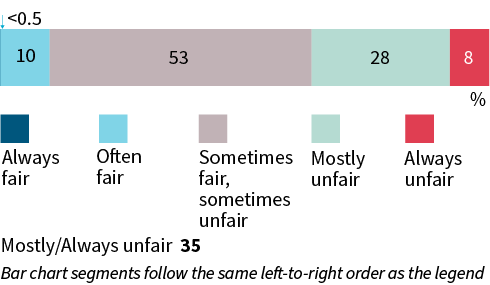
FAIR1. Thinking about how organisations collect, use and share personal information in Australia today, how often do you feel these data practices are fair in real life, rather than just on paper (e.g. in privacy policy or terms and conditions)?
Base: All Australians aged 18+. (n=1,504)
Notes: Don’t know (0%) and refused (0%) not displayed.
When data collection feels acceptable
About 9 in 10 (92%) Australians find data collection acceptable under certain conditions. Australians are more likely to accept data collection when:
- the purpose is clear and specific (69%)
- they can opt in or consent (68%)
- when only the minimum necessary information is collected (66%)
- they can opt out of non-essential collection (61%).
Safeguards and trust also play a role, though are less prominent, including limits on how long data is kept (52%) and trust in the organisation (44%).
Figure 30 Situations in which collecting personal information feel acceptable
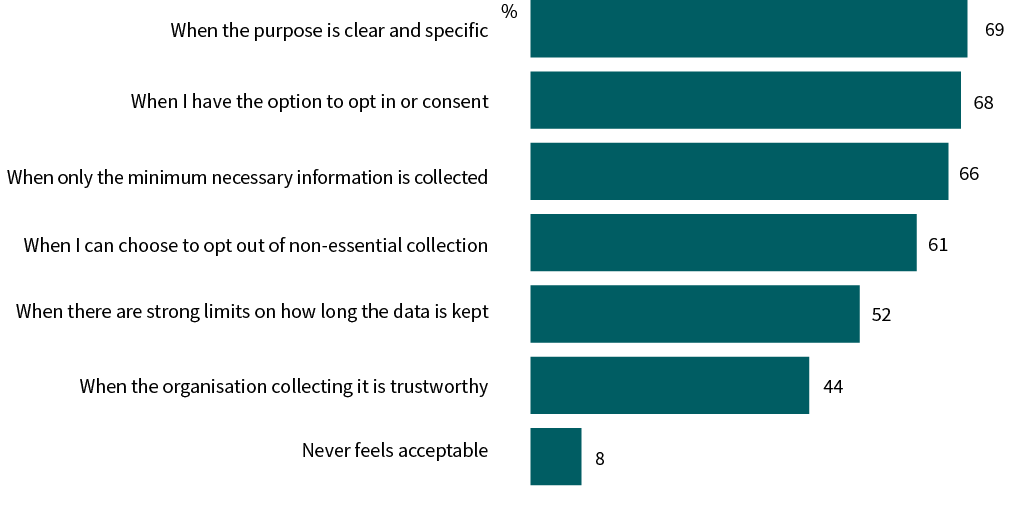
FAIR2. In which situations do collecting personal information feel acceptable to you?
Base: All Australians aged 18+. (n=1,504)
Notes: Don’t know (0%) and refused (0%) not displayed.
Australians typically view practices that involve sensitive data, vulnerable groups, or commercial exploitation as unfair or unreasonable.
Compared to 2023, there has been a slight increase in the proportion who view these practices as unfair or unreasonable across most use cases, except for online tracking, profiling, and targeted advertising to adults using personal but not sensitive information (e.g. work history, age, interests), which is seen as more fair and reasonable in 2026 (30%, up from 24% in 2023).
Strong opposition remains for other practices involving greater risk or harm. More than 9 in 10 Australians consider the below activities to be unfair or unreasonable:
- Sale or trading of personal information (96%, up from 87% in 2023).
- Online tracking, profiling and targeted advertising to children (96%, up from 89% in 2023) or vulnerable individuals (e.g. gambling companies targeting gamblers) (95%, up from 88% in 2023).
- Location tracking where not required for a location-based service (94%, up from 87% in 2023).
- Training AI models and products such as chatbots (93%).
- Data scraping from online platforms (e.g. collecting photos of people from social media platforms without their knowledge) (92%, up from 81% in 2023).
- Differential pricing (e.g. different people being shown different prices based on their browsing history, location, device type or past purchases) (91%).
- AI-informed decision-making that has a significant effect on an individual (e.g. for hiring decisions or to assess eligibility for a loan) (91%, up from 70% in 2023).
- Targeted advertising based on sensitive information (e.g. health information, racial or ethnic origin) (91%, up from 84% in 2023).
Drivers of perceived unfairness
Australians are most likely to perceive data handling as unfair when there is a lack of transparency and excessive collection. The top concerns are:
- not knowing how information will be used or shared (81%)
- not knowing how or where it is stored (76%)
- excessive data collection, including when the amount collected is not proportionate (70%) or could be reduced (67%).
Many also see data handling as unfair when they do not have meaningful choice or control, including when:
- they cannot refuse or limit practices (66%)
- They feel the organisation has power over them (61%)
- the risks of data use are not justified by the benefits (59%).
Limits on what data should not be collected
Australians strongly believe that there are limits to what personal information organisations should collect, regardless of the purpose, with over 9 in 10 (92%) holding this view. This sentiment is more pronounced among older Australians aged 50+ (95% vs 89% of those aged 18–49).
Views about what constitutes excessive or unjustified data collection vary strongly by the sensitivity of the information. Australians are most likely to view the collection of sensitive and intrusive information as excessive or unjustified in most situations, regardless of the organisation or purpose, including data such as sexual orientation (72%), biometric information (71%), behavioural or psychological data (68%), and detailed online tracking (65%), as well as financial information and religion (both 62%).
By contrast, more basic identifying information is less likely to be seen as excessive, with relatively few viewing details such as date of birth (19%), address (17%), phone number (14%), name (8%), or email address (8%) as unjustified to collect.
Older Australians aged 50+ are more likely than younger Australians to view the collection of most types of personal information as excessive or unjustified, regardless of the organisation or purpose.
Figure 31 Types of personal information collection that feel excessive or unjustified in most situations
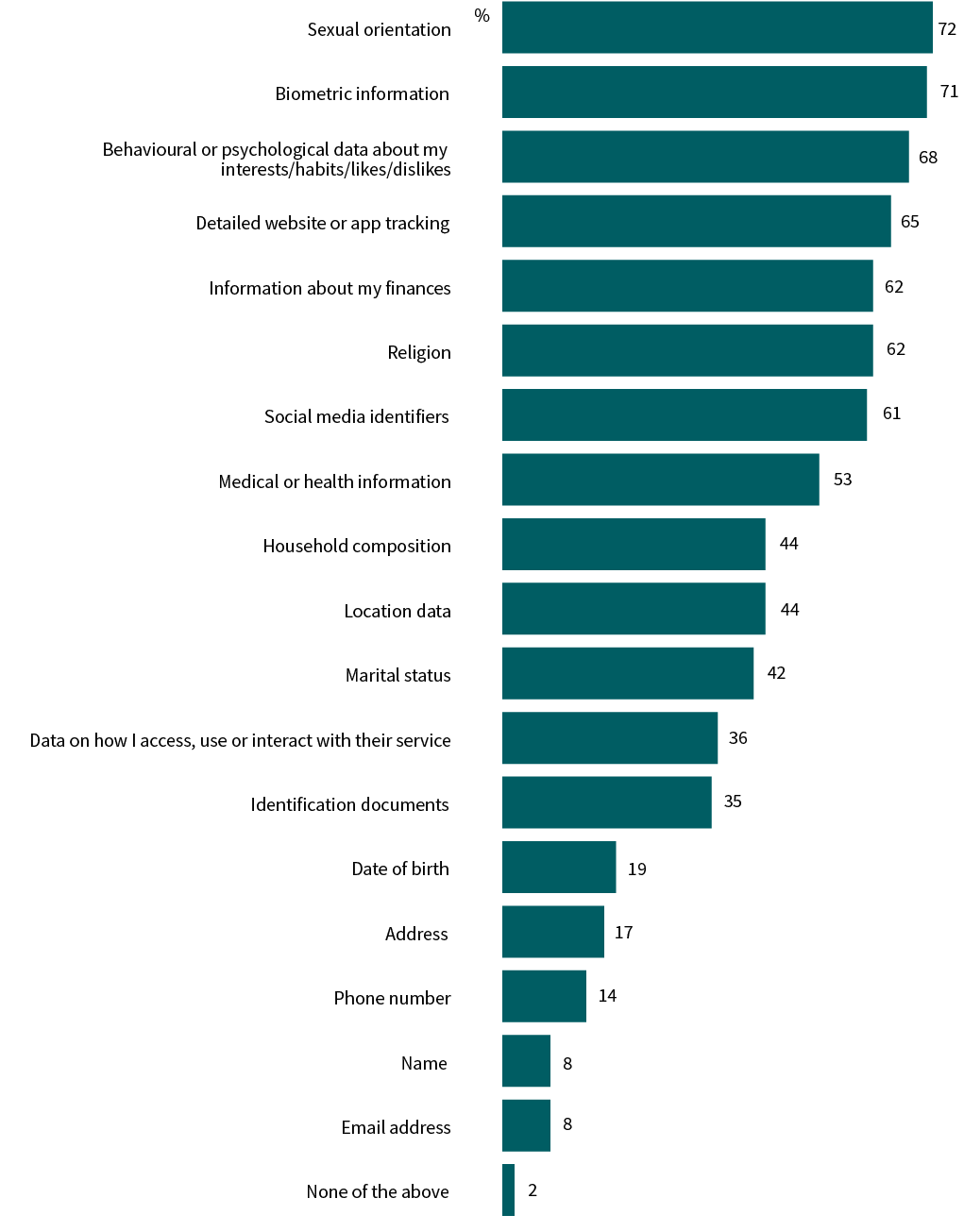
COL2. Which types of personal information collection feel excessive or unjustified to you in most situations, regardless of the organisation or purpose?
Base: All Australians aged 18+. (n=1,504)
Notes: Don’t know (1%) and refused (<0.5%) not displayed.
Concerns about overseas data transfers
Concern about organisations sending personal information overseas has increased since 2023, with nearly all Australians now expressing some level of concern (97% vs 91% in 2023), including a larger share who are very concerned (63% vs 41%).
Concern is higher among older Australians aged 65+ (82% very concerned vs 58% of those aged 18–64), while younger Australians aged 18–34 are more likely to be somewhat rather than very concerned (45% vs 29% of those aged 35+), though concern remains widespread across all age groups.
Figure 32 Concern about organisations sending personal information overseas
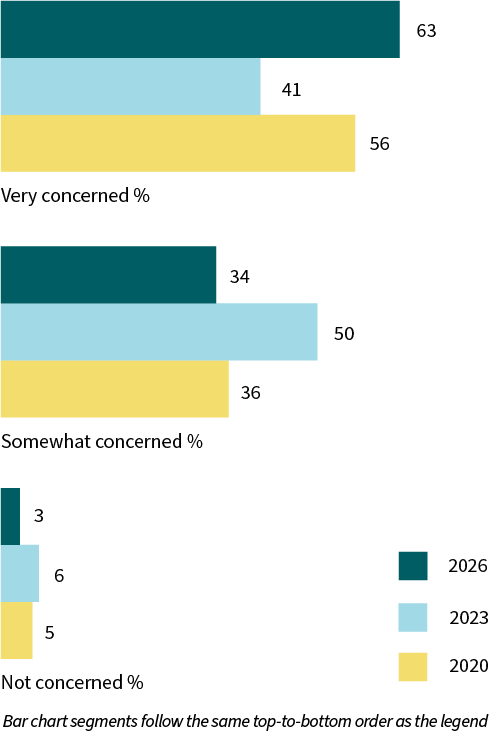
F4. Now thinking more broadly again, how concerned are you about organisations sending their customers’ personal information from Australia to overseas?
Base: All Australians aged 18+. (2026: n=1,504, 2023: n=1,642, 2020: n=1,505)
Notes: Don’t know (0% in 2026, 3% in 2023, 2% in 2020) and refused (0%) not displayed.