-
On this page
Report summary
This report by the Freedom of Information Commissioner examines the disclosure logs of 30 agencies to assess their compliance with s 11C of the Freedom of Information Act (FOI Act) and the OAIC’s FOI guidelines. These 30 agencies account for 75% of all the non-personal FOI requests granted during the 2024-25 financial year. The FOI Commissioner has made recommendations so that agencies can better meet their FOI-Act obligations and so that information released under the FOI Act can be easily accessed by members of the public.

30
agency websites reviewed
Disclosure logs are where agencies publish information, subject to certain exceptions, that is released in response to freedom of information (FOI) requests made by members of the public. This publication of information fulfills the legislative requirement under s 11C of the FOI Act.


Agency FOI disclosure logs available under the Freedom of Information Act 1982.
Key findings
Most agencies could improve their disclosure log to promote transparency and searchability
20 of 30
agencies had not met their legislative obligation to publish information within 10 working days after access is granted
16 of 30
agencies had not published all required information released under the FOI Act on their disclosure log

10 of 12
agencies that provided relevant information do not accurately report the number of disclosure log entries published on their disclosure log to the OAIC
Recommendations
This report makes the following recommendations to assist agencies in making improvements to their disclosure logs and fulfil their obligations under the FOI Act.

Recommendation 1: Agencies should review the format of, and information on, their disclosure logs and ensure they align with both the disclosure log obligations in section 11C of the FOI Act, the objects of the FOI Act and the FOI Guidelines.
Specifically, agencies should:
- ensure information on their disclosure log is searchable and where needed, make enhancements to improve searchability
- ensure all disclosure log entries have a sufficient and accurate description
- publish both the access and publication date for each disclosure log entry
- provide direct access to the documents released wherever possible and provide an explanation when it is not possible to do so
- consider a practical way to provide archived information for historical disclosure log entries to the public.

Recommendation 2: Agencies should prioritise publication of documents released in response to FOI requests to ensure they comply with the requirement to publish documents within 10 working days of access being given to the applicant.
Recommendation 3: Agencies should publish documents released under the FOI Act as new entries on their disclosure log. This includes:
- when an agency releases documents, or parts of documents, following an internal review, an IC review or after an Administrative Review Tribunal (ART) review
- when information in the documents, or the documents themselves, are published on a third-party website in response to an FOI request

Recommendation 4: Agencies should ensure their FOI reporting processes and procedures are sufficiently robust to provide the correct number of disclosure log entries to the OAIC, including undertaking revisions to these processes and procedures where needed.
Foreword
The objects of the Freedom of Information Act 1982 (FOI Act) are explicit in the intention to promote Australia’s representative democracy. The FOI Act recognises that government information is a national resource and access to this information supports transparency, accountability and public participation in government decision-making. The objects instruct us to exercise the powers and functions of the FOI Act ‘to facilitate and promote public access to information, promptly and at the lowest reasonable cost’ (s 3(4)).
Publishing information on disclosure logs is an obligation under the FOI Act which is intended to support transparency and efficiency. Disclosure logs highlight information that is frequently sought under the FOI Act and which could be proactively released by agencies. This is also an effective strategy for reducing multiple FOI requests for the same information.
Proactive disclosure of government information provides an important bulwark against misinformation and disinformation in an increasingly complex information environment. Government information can often present a source of truth to the community, where mis and disinformation are present. In an information landscape where government resources struggle to meet increasing demand and community expectations, it is critical we turn to initiatives that anticipate public need and have the dual impact of improving service delivery and increasing transparency.
The Commonwealth Integrity Strategy commits to transparency and accountability of actions and decisions being improved; and enhancing public trust and confidence in the Commonwealth public sector.[1] This strategy makes it clear that transparency is an accepted principle of the Australian democratic fabric, of which FOI and its efficient administration is an integral part. To further this transparency, in March 2026, the OAIC launched a disclosure log hub, collecting links to all the commonwealth disclosure logs to allow for easy access.[2]
Good disclosure log practice is also a positive sign of good administration of the FOI Act. Disclosure log compliance is a useful tool to assess whether an agency understands and is responsive to the objects of the FOI Act and the intention of the framework, as with all statutory compliance, the means to understand and implement best practice is critical to improvement.
The Office of the Australian Information Commissioner (OAIC) is an independent regulatory agency and is a member of the Commonwealth integrity framework.[3] We last examined agency disclosure log practices in 2021. Since that time, disclosure logs have remained a practical and visible way for agencies to demonstrate their commitment to open government. This review provides a snapshot of current disclosure log practices across Australian Government agencies as well as the extent to which they are meeting their obligations under the FOI Act. We identify both positive practices and opportunities for improvement.
A critical issue in FOI administration is timeliness. The FOI Act has timeframes that must be complied with to meet the objects of the FOI Act. This is often discussed in the context of the statutory timeframes for decision making and the time taken to release documents when requested by members of the public. However, publishing relevant documents released in response to FOI requests on disclosure logs in a timely way is another simple way to improve the FOI experience. Timeliness is a core part of whether the FOI system feels fair and trustworthy and links directly to the OAIC’s regulatory focus on ensuring timely access to government information.
FOI is not an abstract ideal. It underpins public participation, scrutiny and confidence that decisions are being made for the public good. When it functions correctly, FOI promotes trust in the public service, as this trust has been shown to be contingent on transparency and good communication.[4]
FOI systems, which include accurate disclosure logs, are not just about meeting statutory obligations; they are about building trusted workable systems, clear processes and practical support. The OAIC’s disclosure log hub is a practical tool that the community can use to find and access all the Commonwealth’s disclosure logs.[5] These priorities build on the work agencies are doing to drive administrative excellence of the realisation of the right to access government information and this report is intended to assist agencies in this endeavour.
I encourage agencies to consider this report and review their own practices where appropriate.
Alice Linacre PSM
Freedom of Information Commissioner
Executive summary
A key object in the FOI Act is ‘to facilitate and promote public access to information, promptly and at the lowest reasonable cost’ (s 3(4)). The FOI Act also recognises that government-held information is a national resource to be managed for public purposes. When the FOI Act was amended in 2010, the second reading speech reflected that ‘this legislation expressly recognises that giving the Australian community access to government-held information strengthens Australia’s representative democracy, recognises the role that this object serves to increase public participation in government processes and increases accountability in the government’s activities.’[6]
The FOI framework promotes and supports these objectives by providing the public with the right to access government-held information on request, with some exceptions. This pro-transparency approach is also facilitated by certain requirements for proactive publication.
In particular, agencies and ministers are required under law (s 11C of the FOI Act) to publish documents released in response to an FOI request within 10-working days of release, subject to certain exceptions. This publication is known as a ‘disclosure log’. The purpose of the disclosure log is to proactively make available to the public information that has been released under the FOI Act.[7]
Compliance with disclosure log requirements is an ongoing statutory responsibility for agencies and ministers subject to the FOI Act. Disclosure logs provide the public with an important and cost-effective avenue for accessing government information while providing agencies and ministers with the ability to reduce the resources required to deal with multiple requests for the same information.
This report provides our findings from a desktop review of 30 agencies’ compliance with disclosure log provisions in the FOI Act. From January to March 2026, the OAIC conducted a desktop review of 30 agencies to determine their compliance with the FOI Act and the better practices outlined in the FOI Guidelines.[8] The purpose of this desktop review is to provide guidance, and make findings and recommendations, so that agencies can improve their disclosure log processes and practices. This will assist members of the public to easily access information released under the FOI Act in a timely way.
The findings of this report are consistent with the findings of the Australian National Audit Office in their recent report: Auditor-General Report No. 32 2025–26: Administration of the Freedom of Information Act 1982 by Selected Entities, published in May 2026. The ANAO examined compliance with the FOI Act by three entities (Department of Prime Minister and Cabinet, the Treasury and the Department of Infrastructure, Transport, Regional Development, Communications, Sport and the Arts) and made findings relevant to each of those agencies and to the Office of the Australian Information Commissioner (OAIC). Compliance with disclosure logs was examined by the ANAO in that report and findings that went to the need for searchable disclosure logs and to the inclusion of data that informed timeliness of entries are also raised in this desktop review. The three agencies that were the subject of that audit are included in the 30 agencies that informed the desktop review of this report.
This report builds on the OAIC’s previous desktop review of compliance with disclosure log requirements, undertaken in 2021.[9] We have reassessed certain criteria – in particular, how the public can search for and access information released under the FOI Act,[10] and assessed new criteria, to evaluate agencies’ current compliance with s 11C of the FOI Act.[11] We note that although there is some improvement since we conducted our earlier review, we consider agencies can continue to lift their practices and compliance, for example with respect to providing clearer descriptions of released documents on their disclosure logs.
In this current report we found that, overall, all the agencies assessed maintained disclosure logs that were largely compliant with their disclosure log obligations – with the exception of the obligation to publish within 10 working days of release. In addition to this issue of timeliness, we identified certain other areas that can be improved upon, and this report sets out our findings and suggestions in this regard. In particular, with respect to key areas where improvement was needed for some of the agencies assessed, we found that:
- 3 agencies (10%) had disclosure logs that could not be easily searched for information.
- 5 agencies (16.67%) did not provide sufficient information for over 20% of their disclosure log entries, limiting the ability of the public to search for and understand what information had been released under the FOI Act.
- 4 agencies (13.33%) required members of the public to contact the agency to obtain documents from their disclosure log, with no ability to directly download the documents.
- 20 agencies (66.67%) only provided one of either the access date (the date information was disclosed to the recipient) or the publication date (the date this information was entered into the disclosure log). One agency (3.33%) provided no dates.
- 5 agencies (16.67%) did not provide any information on historical or archived disclosure log entries.
- 20 agencies (66.67%) did not state whether their disclosure log included disclosure log entries for the relevant minister, or a related portfolio agency. Although this clarification is not currently included in the FOI Guidelines, it would provide greater transparency to the public about where to find information released by ministers in response to FOI requests.
- 20 agencies (66.67%) had not published all disclosure log entries in the 2024-25 financial year within the legislatively required 10 working days after access was given to the applicant. We were unable to assess compliance with this metric for 4 agencies (13.33%).
- 16 agencies (53.33%) had not published all required information on their disclosure log which had been released under the FOI Act. This was assessed by searching for known instances of documents released under the FOI Act on a third-party website and Information Commissioner (IC) review decisions that overturned or varied the agencies’ decision not to release non-personal information.
To ensure that agencies comply with the objects of the FOI Act, we recommend that:
Recommendation 1:
Agencies should review the format of, and information on, their disclosure logs and ensure they align with both the disclosure log obligations in section 11C of the FOI Act, the objects of the FOI Act and the FOI Guidelines. Specifically, agencies should:
- ensure information on their disclosure log is searchable and where needed, make enhancements to improve searchability
- ensure all disclosure log entries have a sufficient and accurate description
- publish both the access and publication date for each disclosure log entry
- provide direct access to the documents released wherever possible and provide an explanation when it is not possible to do so
- consider a practical way to provide archived information for historical disclosure log entries to the public.
Recommendation 2:
Agencies should prioritise publication of documents released in response to FOI requests to ensure they comply with the requirement to publish documents within 10 working days of access being given to the applicant.
Recommendation 3:
Agencies should publish documents released under the FOI Act as new entries on their disclosure log. This includes:
- when an agency releases documents, or parts of documents, following an internal review, an IC review or after an Administrative Review Tribunal (ART) review
- when information in the documents, or the documents themselves, are published on a third-party website in response to an FOI request.
Recommendation 4:
Agencies should ensure their FOI reporting processes and procedures are sufficiently robust to provide the correct number of disclosure log entries to the OAIC, including undertaking revisions to these processes and procedures where needed.
These recommendations will assist agencies in fulfilling the objects of the FOI Act; and provide timely access to documents of public interest released under this legislation. We urge senior leaders to engage with them as a key component in a commitment to the FOI framework including principles of proactive release. This approach is consistent with the APS value of stewardship, including supporting the public interest now and in the future, and contributing to an effective, trusted, and sustainable APS.[12]
Additionally, accountability is a key strategic priority of the Commonwealth Integrity Strategy, whereby the Commonwealth public sector is to be accountable for, and transparent about, integrity matters. FOI plays a vital role in providing the public with information which in turn, promotes trust in the integrity of the public sector.[13] The OAIC is an independent regulatory agency comprising part of the Commonwealth integrity framework[14] and the recommendations in this report intend to promote and foster these priorities across the public service.
What the OAIC commits to
Part 14 (Disclosure log) of the FOI Guidelines and checklists are currently being reviewed and created to ensure the guidance is clear and up to date, as well as highlighting the better practices outlined in this report. The updated guidance will be subject to consultation before being issued by the Australian Information Commissioner under section 93A of the FOI Act.
FOI disclosure logs and public access to information
The objects of the FOI Act include recognition that information held by Government is to be managed for public purposes and is a national resource. In enacting the FOI Act, Parliament intended to promote Australia's representative democracy by increasing public participation in Government processes with a view to promote better‑informed decision-making and increase scrutiny, discussion, comment and review of the Government’s activities.[15] One way the FOI Act achieves this is through legislating that agencies and ministers must publish information in response to every FOI request, subject to certain exceptions. These publications are made available by what is commonly known as a ‘disclosure log’.
Relevant legislation
Section 8(g) of the Australian Information Commissioner Act 2010 (AIC Act) gives the Freedom of Information Commissioner (FOIC) power to monitor, investigate and report on compliance by agencies with the FOI Act.
As well as providing a right of access to documents, the FOI Act requires agencies to publish certain information. Section 11C of the FOI Act sets out what information agencies must publish on their disclosure logs, and how and when that information is to be published. Section 11C also includes circumstances in which publication is not required.
Specifically, s 11C requires agencies to publish documents released in response to FOI requests within 10 working days of access being given to the FOI applicant. This is generally referred to as an agency’s ‘disclosure log’. This requirement is subject to exceptions that may apply to personal, business, commercial, financial or the professional affairs of any person, if it would be unreasonable to publish the information.
Disclosure logs reinforce the objects of the FOI Act that promote proactive publication of information (s 3(1)(a)) and recognise that information held by government is a national resource (s 3(3)).
Agencies are required to publish information or documents released under the FOI Act to members of the public generally on a website. Section 11C(3) of the FOI Act requires agencies to publish information or documents by making them available by: direct download from their own website; linking to another website from which the documents/information may be downloaded or; publishing information about how the documents/information can be obtained.
By making previously released documents available for download or on request, agencies provide greater access to government information and prevent multiple, identical requests for already released information.
When performing functions or exercising powers under the FOI Act, agencies must have regard to the FOI Guidelines issued by the IC. Part 14 of the Guidelines issued by the IC under s 93A of the FOI Act (the FOI Guidelines) provides guidance for agencies on how to establish and maintain their disclosure logs.[16]
The OAIC 2021 disclosure log review
The OAIC’s previous report on compliance with the disclosure log obligations in s 11C of the FOI Act was published in 2021.[17] That report assessed 38 agencies and examined the introduction to the disclosure log, the description of disclosure log entries (including what dates were provided with each entry), the format and accessibility of documents, whether documents were available for download, information about charges and the timeframe for the removal and archiving of documents. Using this important information to inform our current understanding, we reassessed 2 of these criteria in this report; the description of disclosure log entries and whether the documents released were available by download.
The ability of the public to access documents promptly and at the lowest reasonable cost is one of the objects of the FOI Act. An effective way of fulfilling this obligation is for agencies to provide documents for download from their disclosure logs. Fewer agencies in 2026 required members of the public to contact them to access the documents for every disclosure log entry when compared to 2021.[18] This is a positive sign that more agencies are committing to this object and is pleasing to see. Another sign of improvement is that more agencies are providing both the access and publication date for each disclosure log entry.[19] While this demonstrates an improvement, the majority of agencies still only provide one of these dates. Providing both the access and publication date for each disclosure log entry is an important transparency mechanism in respect to the time of publication and agencies’ compliance with s 11C(6).
There continues to be a need for general improvement in the quality of the descriptions for individual disclosure log entries. The 2021 report concluded that ‘some agencies do not provide a clear description of the released documents’ and we again found this to be the case. Without a clear description of what was released it is difficult for members of the public to search for and identify what the documents contain and decide whether to request access. This places an unnecessary barrier between the public and government-held information and increases work for agencies in responding to requests for access to disclosure log documents. Agencies should prioritise providing accurate and informative descriptions for each disclosure log entry to facilitate the public’s timely access to government held information.
The 2021 report was unable to assess agencies on their compliance with the legislated 10 working day publication timeframe because only 2 agencies provided both the access and publication date on their disclosure log. As more agencies now provide this information, and by adopting new methodologies, the current report was able to better assess agencies’ compliance with the 10 working day publication requirement in s 11C(6). Based on publicly available information we found that 66% of the reviewed agencies had not published all their disclosure log entries within the legislated timeframe. Publishing disclosure log entries within 10 working days of the day after access is given is a legislative requirement and agencies are obliged to adhere to this timeframe.
What does the OAIC recommend for the design and content of disclosure logs?
The FOI Act does not prescribe the form of a disclosure log, rather it sets out how and why government agencies should publish information released under the FOI Act (subject to the exceptions in s 11C(1)).[20]
A disclosure log has 3 parts:
- the disclosure log (or table) published on an agency’s website, listing the information that is available for public access following a FOI request which is referred to as a ‘disclosure log entry’ in this report
- the information or documents released following a FOI request, which may be accessible directly from the disclosure log or on request if it is not reasonably practicable to publish the information
- a search function that applies to both the disclosure log and any attached information.
The FOI Guidelines identify what good disclosure log practice involves and includes the following guidance:
- the information on the disclosure log should be searchable with reference to particular words, categories or subject matter [14.57]
- disclosure log entries should have a clear, easy to read, description of the published documents, using search terms the public would use to find documents [14.43]
- information on an agency’s disclosure log should be available for download, except where it is not possible to do so due to technical constraints such as file size or the need for specialist software [14.42]
- documents should be published on an agency’s disclosure log no later than 10 working days after the day the applicant was given access (s 11C(6) of the FOI Act and [14.30] and [14.33] of the FOI Guidelines)
- both the date on which the FOI applicant was given access to the documents and the date on which the documents were published on the disclosure log should be included for each disclosure log entry [14.37]
- access to information that cannot be published on an agency’s disclosure log should be provided on request within 5 days [14.45]
- the agency’s disclosure log should be updated following an internal or external review if the reviewable decision is set aside to provide further access to documents [14.20].
How did the OAIC undertake the review?
Objective
This desktop review of disclosure logs is a regulatory activity that seeks to provide guidance and make recommendations to promote improvements to disclosure logs so that information released under the FOI Act can be easily accessed by members of the public.
Additionally, this desktop review provides the OAIC with the opportunity to assess the current state of agencies’ disclosure logs through a risk-based lens, highlight better practices that agencies have employed in managing their disclosure logs and promote public awareness about the release of government information under the FOI Act.
Ensuring timely access to government information and promoting a proactive approach to the publication of government-held information are key priorities for the OAIC. This report supports these priorities by discussing:
- how agencies make information released under the FOI Act available to the public on their disclosure logs
- whether agencies publish sufficient information about disclosure log entries so members of the public can easily search for and identify information released under the FOI Act
- whether agencies publish documents on their disclosure logs within 10 working days of access being given to the FOI applicant
- how accurate agencies are in reporting disclosure log statistics to the OAIC.
Methodology
How agencies were selected for the desktop review
As of November 2025, there were 292 agencies subject to the FOI Act, as listed on the FOI statistics database.[21] All these agencies are required to publish information in documents released in response to FOI requests on a disclosure log under s 11C of the FOI Act.
Consistent with the OAIC’s guiding principles, we adopted a risk-based approach by selecting the 10% of agencies that gave access in response to the most requests for non-personal documents,[22] either in full or in part, in the 2024-25 financial year (30 agencies). These 30 agencies account for 75% of all the non-personal FOI requests granted during the 2024-25 financial year. We did not assess any minister’s disclosure logs in this review. A list of these agencies can be found in Appendix A and are:
- the 16 Australian Government Departments subject to the FOI Act as of November 2025
- the 14 agencies that granted full or partial access to the largest number of non-personal FOI requests in 2024–25.
Targeting agencies that give access to the most non-personal information provides the best overview of how agencies are publishing information in documents released in response to FOI requests as required by the FOI Act.
The timeframes for the desktop review
The information for this desktop review was collected in the period January to March 2026, and all findings and recommendations are made based on the information available during this time.
The review assessed each agency’s disclosure log over 2 timeframes: the 2024-25 financial year and quarter one of the 2025-26 financial year (1 July to 30 September 2025). These timeframes aligned with the agencies’ reporting obligations and provided scope to effectively assess their approach to managing their disclosure logs.
What information was collected for the desktop review
This desktop review assessed compliance with the obligations in s 11C(3) and (6) of the FOI Act and Part 14 of the FOI Guidelines. We did not assess agencies’ compliance with s 11C(4) and (5) of FOI Act which relate to charges an agency may impose and information about these charges that the agency must provide on the disclosure log.
To best achieve the objectives described above, while having regard to the relevant parts of s 11C of the FOI Act and the FOI Guidelines, each agency’s disclosure log was assessed using the below criteria.
- How documents released under the FOI Act were made available; by direct download from the disclosure log, published on another website, or only available on request.
- How disclosure log entries, documents or topics can be searched for on the disclosure log.
- The adequacy of the description provided for each disclosure log entry so members of the public can make an informed decision about whether to download or request a copy of the documents.
- Whether the date of access and/or the publication date for the disclosure log entries was provided.
- If the number of FOI entries published on an agency’s disclosure log was the same as that reported to the OAIC during the 2024-25 financial year.
- If disclosure log entries were published within 10 working days of documents being released to the FOI applicant. This was assessed by analysing the information provided on the agency’s disclosure log, analysing timestamped archived versions of the disclosure logs, or other publicly available FOI requests found on the Right to Know (RTK) website.[23]
- Whether agencies published all the required disclosure log entries and/or documents on their disclosure logs. This was assessed using other known sources of FOI request outcomes such as the RTK website and IC review decisions[24] that had set aside, varied or substituted an agency’s decision to refuse access to requested documents.
Information on how this information was analysed can be found in Appendix B.
Limitations of the desktop review
This desktop review is based on information provided to the OAIC prior to this review, as well as publicly available information. We did not seek clarification from any of the reviewed agencies with respect to the information that was present on the disclosure logs at the time of review. We also did not ask for an explanation for discrepancies between the number of new disclosure log entries reported to the OAIC, which are required to be reported each quarter, and what was published on the disclosure logs at the time of this review. Due to these factors, we have not made any findings against any of the individual agencies reviewed with respect to their compliance with the disclosure log provisions in s 11C of the FOI Act.
This desktop review focused on the format and the information published on the agencies’ disclosure logs and how this aligns with s 11C of the FOI Act and Part 14 of the FOI Guidelines. It makes no comment on the agencies’ FOI decision-making processes or whether the documents released by the agency fulfilled the FOI request.
How agencies present their FOI disclosure logs and make information publicly available
The layout of the disclosure log provides an entry point for members of the public who seek access to government information. It is important that agencies provide clear information about the disclosure log and how access to released documents can be obtained. Members of the public should be able to easily identify the nature of the information on the disclosure log so they can make an informed choice when searching, downloading or obtaining government information. Furthermore, publishing documents to facilitate public access reduces an agency’s costs of processing requests for the same or similar information.
All 30 agencies published information released in response to FOI requests, subject to the exceptions in s 11C of the FOI Act, on a disclosure log. Of the 30 agencies, 29 disclosure logs could be easily found using key search terms such as ‘FOI disclosure log’ in the search bar on the agency’s home page. The disclosure log that could not be found using this method could be found through the ‘freedom of information’ hyperlink on their home page.[25]
Each of the disclosure logs maintained by the agencies that were assessed for this review can also be found at the recently published OAIC disclosure log hub: Agency FOI disclosure logs. This hub provides easy access to over 240 agency disclosure logs and reinforces the objects of the FOI Act by promoting proactive publication of information held by the government.
How the disclosure log is displayed
There is no prescribed way to display a disclosure log, and this formatting choice is at the discretion of the agency.[26] We observed that agencies generally display their disclosure logs in one of 3 ways; a single webpage that contains all the entries on the current disclosure log, a separate webpage for each year/quarter, or a single disclosure log that can include several years disclosure log entries and has a specific number of entries per page. The following observations assisted us in assessing the functionality, transparency and searchability of disclosure logs.
Figure 1 shows how many agencies display their disclosure logs in these 3 ways, with almost half of the agencies choosing to display their current disclosure log with a specific number of entries per page. There was no conformity amongst agencies for the start date for this type of disclosure log display and disclosure log entries could cover a wide time-period, with the earliest disclosure log beginning in 2011. This was also true for agencies that chose to display their disclosure logs per year or quarter with 2 beginning in 2017, 1 in 2015 and 4 in 2011.
In addition to the one of the 3 presentation styles outlined above, 3 agencies also had a separate page for each disclosure log entry. This page was dedicated to a single disclosure log entry that could be accessed through a hyperlink embedded in the disclosure log and had either a copy of the document or an explanation of how to access the document, and sometimes an expanded description of the document. This approach represents best practice.
Are ministers’ or other related agencies’ disclosure log entries present on the agency’s disclosure log?
Ministers are also subject to s 11C of the FOI Act and are obliged to publish information that has been released in response to FOI requests, subject to the specified exemptions noted above. Agencies may assist their minister by publishing this information on the agency’s disclosure log.
We observed that 2 agencies also published FOI disclosure log entries for associated agencies and boards they oversee that are also subject to the FOI Act. There is no requirement or prescribed way for agencies to provide access to their minister’s, or other associated agencies’, disclosure log entries. Statutory accountability under the FOI Act may be reduced without a clear statement that the agency is also publishing documents released in response to FOI requests to the relevant minister or associated agency and boards and how the public can identify those documents.
Portfolio agencies are less likely to publish a minister’s disclosure log entries as this task is generally undertaken by the department. Of the 14 portfolio agencies reviewed, only one clearly published documents released in response to FOI requests made to its minister on their disclosure log. The other 13 portfolio agencies did not indicate on their disclosure logs that they published documents requested from their minister and were therefore assigned to the category ‘not applicable to agency’ (Figure 2).
Figure 2 shows how agencies provided access to documents released in response to requests to the relevant minister. Eight agencies (7 departments and 1 portfolio agency) clearly provide their ministers’ disclosure log entries in a transparent and searchable way either by being able to filter for their disclosure log entries, or by having a separate ministerial disclosure log. Seven departments do not provide any information about whether their disclosure logs also include a minister’s disclosure log entries, or if they did, did not distinguish them from the department’s disclosure log entries (no information). If there is no indication who has released the information, it may be difficult to accurately count the number of disclosure log entries that the department has added to their disclosure log.
Searching for disclosure log entries on the disclosure log
Part 14.57 of the FOI Guidelines is clear that the information on a disclosure log should be searchable with reference to particular words, categories or subject matter. We found that 27 of the 30 agencies’ disclosure logs could be searched primarily by one of these 2 methods; through an embedded search bar for the disclosure log, or by presenting the disclosure log on a single page so that it can be searched through the browsers ‘find’ function (Figure 3).
We observed that 3 agencies did not have disclosure logs that were easy to search. We found that of these agencies:
- One agency did not have an embedded search bar and its disclosure log displayed only 15 entries per page. We found that this type of disclosure log presentation was not easy to search by category or subject matter due to the small number of entries on each page of the disclosure log.
- Two agencies had each disclosure log entry in a drop-down box where the only information immediately visible was the heading, which was brief and not descriptive. A more detailed description for each disclosure log entry could only be accessed when the drop-down box was opened. As there was no embedded search bar and the description was hidden, these 2 disclosure logs were not easily searchable by either of the 2 methods described above.
These 3 agencies did not meet the standard laid out in FOI Guidelines, as the IC recommends that the disclosure log be easily searchable to facilitate accessibility to documents released in response to FOI requests [14.57].
Do disclosure log entries have sufficient and accurate titles and/or descriptions?
The FOI Guidelines [14.43] recommends that any disclosure log entry description should be sufficiently detailed to allow the public to understand what the documents contain, so that a person can make an informed decision about whether to request a copy. While not explicitly stated in the FOI Guidelines, all the titles and descriptions provided with the document need to sufficiently and accurately identify the content so that the public can search for, and understand, the information that has been made available. This is a best-practice approach to fulfill one of the objects of the FOI Act, namely, to facilitate and promote public access to information.
To assess whether agencies provide sufficient descriptive information for each disclosure log entry, we reviewed the information on agencies’ disclosure logs for the period 1 July 2024 to 30 September 2025. Each disclosure log entry was assessed for the presence of key words, relevant dates, and document type (brief, policy, email etc). Only information provided on the disclosure log was assessed as this is what the public can use to search for documents using the disclosure log search functions provided by the agency. For more information see Appendix B.1.
As shown in Figure 4, the majority of disclosure log entries we reviewed contained sufficient information (25 out of 30 agencies had sufficient information in at least 80% of disclosure log entries). However, this means that most of the disclosure logs had some entries that could have benefited from more information in the title or description to assist members of the public in finding documents of particular interest. Examples of typical disclosure log entries with insufficient information are those that:
- only have a reference number for a contract, grant, or current or previous FOI decision with no other information
- contain acronyms that are not widely known and have limited context in the description or title
- refer to ‘briefing’ documents or government submissions with no information on the topic
- refer to ‘communications’ without information on the topic, the sender/recipient or any relevant dates
- refer to ‘legal matters’ or ‘advertising’ with no information on the topic.
We observed some instances where the descriptions provided with the disclosure log entry did not match what was in the published document. These disclosure log entries included either incorrect or misleading information. It is important that all disclosure log entries have accurate information attached to them to fulfil the objects of the FOI Act.
The best descriptions and titles were succinct, contained relevant key words, relevant dates and what type of document (for example, brief, policy, email) was released. A third of the agencies published the terms of the FOI request on their disclosure log made by the applicant – in part or in full. While this is not a legislative requirement, it did assist in providing context to each disclosure log entry. A caveat to this observation is that as there is no obligation to publish the FOI requests.
How do agencies provide access to the documents described on their disclosure logs?
Section 11C requires publication of information contained in documents to which access has been granted under the FOI Act, rather than publication of the documents themselves. However, the FOIC is of the view that agencies should endeavour to make all required documents released in response to FOI requests available for download from the disclosure log or another website, unless it is not possible due to a technical impediment such as file format or size ([14.7] of the FOI Guidelines). Furthermore, where full pages of the document have been redacted before they were released, agencies should consider deleting the blank pages from the document to be published on the disclosure log. This approach is consistent with the objects of the FOI Act.
Figure 5 describes each agency’s approach to providing access to documents released in response to FOI requests. For the timeframes that were assessed, 14 of the 30 agencies made all documents available for immediate download, either directly from the disclosure log or through another website. A further 4 agencies made all their documents available only by requesting them from the agency’s FOI team. No explanation was given as to why these agencies could only grant access to the released documents by this method.
The remaining 12 agencies required members of the public to contact the agency to access some of the documents described on the disclosure log. One of these 12 agencies has recently adopted the policy of providing all documents by direct download, so although it is in the category of ‘Some documents require contacting agency - no explanation provided’, it is notable for its commitment to improving direct access to documents.
Two of the 12 agencies that required they be contacted to obtain access to some documents explained why each entry can only be accessed on request. The reasons given included the file size or the document content being rated 18+. The remaining 10 agencies did not give any reasons for not making documents available by direct download. While we did not ask the agencies why documents were not able to be provided by direct download, by assessing the documents’ description we could not always determine a clear reason why some documents were only available by contacting the agency. Without a clear reason for such an approach, an agency’s commitment to transparency and accessibility could be called into question. To be seen as upholding the objects of the FOI Act, it is better practice to provide direct access to documents released under the FOI Act or provide an explanation when this is not possible.
What dates do agencies publish with each FOI disclosure log entry?
Section 11C(6) of the FOI Act requires agencies to publish documents released in response to FOI requests within 10 working days of access being given access to the document, unless an exception to the disclosure log requirement applies (s 11C(1)).
Since March 2022, [14.37] of the FOI Guidelines has recommended that the date the FOI applicant was given access to the documents (the access date) and the date the documents were published on the disclosure log (the publication date) are published on the disclosure log. Publishing both dates provides transparency and accountability in relation to the agency’s compliance with s 11C(6).
We found that only 10 of the 30 agencies reviewed provided both the access date and the publication date as recommended in the FOI Guidelines (Figure 6). The remaining 20 agencies only published one of either the publication date or the access date or did not publish a date at all.
Do agencies provide access to archival disclosure log information?
While the FOI Act is silent about how long information must remain on the disclosure log, [14.85] of the FOI Guidelines recommends that the information listed on a disclosure log entry should be retained, even if the documents or the disclosure log entry is removed from the current disclosure log. Over time, the disclosure log provides a valuable current and historical record of information released by an agency under the FOI Act. We observed that 25 of the 30 agencies provided information about how to access archived disclosure log items or they retained access to information about older entries on their current disclosure logs. However, one of these 25 agencies provided access to their archived disclosure logs, but states that they remove documents after a year and the public needs to contact them for access to the documents, which we do not consider is consistent with the objects of the FOI Act. Overall, the approach by most of the agencies is consistent with [14.85] of the FOI Guidelines as described above. Additionally, 4 of these 25 agencies also provided information on how to access information about disclosure log entries from previous iterations of the agency, other associated agencies, and former portfolio ministers.
The remaining 5 agencies provided limited or no information about historical or deleted disclosure log entries and did not provide access to archived disclosure logs. Three of these 5 agencies stated that disclosure log entries are removed after a certain amount of time (generally 1 to 3 years) but provide no further information. The earliest disclosure log entry for the other 2 agencies was within the last 5 years, but there was no information stating that items had been removed from the disclosure log, or where archived information could be accessed by the public. As a result, these 5 agencies did not meet the standard laid out in [14.85] of the FOI Guidelines, which recommends that evidence of a disclosure log entry be publicly retained in some way, for transparency and posterity.
Better practice disclosure logs
While only a few disclosure logs met all the better practices outlined in the FOI Guidelines, a large majority of the disclosure logs we reviewed employed some of the better practices recommended by the FOI Guidelines. We note that this list of better practices is not exhaustive, and more reviewed agencies than the ones listed here engaged in these practices. Nonetheless, we have set out a summary below for guidance and encouragement to other agencies.
- The disclosure logs of the Department of Home Affairs, the Department of the Prime Minister and Cabinet and the Department of Social Services are easy to find on their websites using the global search function.
- The disclosure logs of the Department of Defence, and the Treasury, have an embedded search bar and the ability to filter the minister’s disclosure log entries. Services Australia’s disclosure log is on a single webpage, so despite not having an embedded search function, entries can be easily searched using specific words in the browser’s search function.
- The Department of Infrastructure, Transport, Regional Development, Communications, Sport and the Arts and the Department of Employment and Workplace Relations’ (DEWR) provide sufficient descriptions for each disclosure log entry so they can be easily searched for on their disclosure logs. DEWR is notable in that they make more than one document format type available for download and indicate where personal or business information has been deleted under s 11C(1)(a) in the disclosure log.
- The Department of Agriculture, Fisheries and Forestry provides access to all the documents on their disclosure log by direct download and the Department of Climate Change, Energy, the Environment and Water states why some of their documents need to be obtained upon request if access is required.
- The Department of Industry, Science and Resources and the Australian Securities and Investments Commission provide both the access and publication dates for each disclosure log entry.
By providing this information and employing the better practices recommended by the FOI Guidelines, agencies are furthering an object of the FOI Act by facilitating public access to government information, promptly and at the lowest reasonable cost.
Are agencies publishing all required information released under the FOI Act within 10 working days of access?
Section 11C(6) of the FOI Act prescribes that documents released under the FOI Act are to be published within 10 working days of access being given to the recipient. To determine if agencies were compliant with the 10 working day requirement we used 3 different methods; the dates provided by the agencies on their disclosure logs; assessing timestamped ‘snapshots’ of the disclosure logs from an internet archive website;[27] and comparing dates provided for FOI requests on the Right to Know (RTK) website and the agencies’ corresponding disclosure log entries.
Using these 3 methods, which are further outlined below, we found that 20 of the 30 agencies had not published all their disclosure log entries within the required 10 working days after access was given to the applicant. Due to insufficient information, we could not assess 4 agencies for compliance with s 11C(6) using any of these methods. These findings align with the recently published Auditor-General report on ‘Administration of the Freedom of Information Act 1982 by Selected Agencies’, which found that none of the 3 agencies it audited published all disclosure log entries within 10 working days in 2024.[28] Our analysis, which aligns with the Auditor-General’s report, suggests that compliance with s 11C(6) is a common issue for agencies.
1. Assessing the 10 working day publication requirement using the dates provided by agencies
We found that 10 agencies included both the date that information was given to the recipient (the access date) and the date the corresponding disclosure log entry was published (the publication date) on their disclosure logs. The OAIC recognises that by publicly reporting both dates these agencies are following the guidance provided in the FOI Guidelines and being transparent about whether they are meeting the 10 working day publishing requirement. Using the 2 dates provided on the disclosure log, we assessed how many working days had lapsed before a disclosure log entry was published. For more information see Appendix B.2.
The number of disclosure log entries published for each of these 10 agencies during the 2024-25 financial year and Q1 of 2025-26 is at Figure 7, which includes the number of disclosure log entries that exceeded the 10 working day limit (dark blue) and the average number of days it took an agency to publish those entries after the 10 working day limit was exceeded (red line). We found that from 1 July 2024 to 30 September 2025, 8 agencies had at least 1 disclosure log entry that was published more than 10 working days after access was provided. Four of these agencies published more than 10% of their disclosure log entries over the 10 working day limit, suggesting that their processes need to be reviewed to ensure compliance. The longest time between an agency granting access and publishing the corresponding entry on their disclosure log was 302 days and although this was an outlier, this agency published another 6 disclosure log entries more than 100 days after access was granted.
2. Assessing the 10 working day publication requirement using a publicly available internet archive website
To assess the 10 working day requirement for the 16 agencies that provide only the access date on their disclosure logs we used the wayback machine, a digital archive of the world wide web founded by the nonprofit organisation, the Internet Archive.[29] The wayback machine uses automated ‘crawlers’ to download publicly accessible web pages and store them as ‘snapshots’ so that these web pages can be viewed as they appeared at the specific timestamped moment of capture.
We assessed timestamped snapshots archived during the 2025 calendar year for the 16 agencies that provided only the access date on their disclosure logs. After this initial assessment we excluded 4 agencies from further analysis as there was insufficient information to accurately assess their compliance with s 11C(6) of the FOI Act. For the remaining 12 agencies we compared the timestamped snapshots of their disclosure logs with the current disclosure log present on their websites. We could then determine if there were disclosure log entries that had been published after the legislated 10 working days. We could not establish how long it took to publish disclosure log entries using this method, only that they had not been published within 10 working days of the access date. For more information see Appendix B.3.
We found that 9 agencies had disclosure log entries missing from the relevant period of timestamped snapshots of their disclosure log indicating that these missing disclosure log entries were published more than 10 working days after the access date (Figure 8).
3. Assessing the 10 working day publication requirement using FOI requests made through the RTK website
To assess the 3 agencies that only report the publication date on their disclosure logs, we used information from the RTK website.[30] This not-for-profit website is an online tool for members of the public to make FOI requests and then publishes all the responses from the agency, including the documents released in response to the request and the date that access to the documents was given to the applicant. For RTK FOI requests that were made in the 2025 calendar year and were published on the agency’s disclosure log, we used the date the documents were published on the RTK website as the date of access and the publication date on the disclosure log to assess whether these disclosure log entries were published within 10 working days. For more information see Appendix B.4.
Of the 3 agencies assessed we found that one agency had published their single RTK FOI documents on their disclosure log within 10 working days. The other 2 agencies did not meet the 10 working day publication requirement. One of these 2 agencies had several RTK requests that lead to the release of documents but had only published one of them on their disclosure log 3 months after access was given. The other agency did not publish any of the RTK FOI requests which involved release of documents, on their disclosure log. As these agencies had not published the required information on their disclosure logs, they also did not meet the 10 working day publication requirement.
Are agencies publishing all the required information released under the FOI Act on their disclosure log?
Agencies must publish information that has been released in response to every FOI request, subject to certain exceptions that are set out in s 11C(1) of the FOI Act. Compliance with this requirement requires that agencies publish this information in a central location, namely on the agency’s disclosure log.
One of the metrics that agencies report to the OAIC is the number of new entries added to their disclosure logs each quarter. This information is provided using an online portal. Quarterly reporting by agencies is an important tool for assessing compliance with the FOI Act, which the OAIC oversees.
Are agencies reporting the correct number of new FOI disclosure log entries to the OAIC?
One way to assess compliance with the publication aspect of s 11C of the FOI Act is to compare the number of disclosure log entries added to each disclosure log with what those agencies reported to the OAIC in their quarterly FOI statistical reporting. While not definitive, a difference in these numbers may suggest that disclosure log entries eligible for publication have been missed. However, as the OAIC asks agencies to report the number of new disclosure entries published each quarter, we could only assess the accuracy of the 13 agencies that provided the publication date for each disclosure log entry.
Furthermore, 2 agencies did not report how many disclosure log entries were added to their disclosure logs in their quarterly FOI statistical returns for the 2024-25 financial year despite new disclosure log entries being added during this time. One of these agencies was also one of the 13 agencies that provided the publication date on their disclosure log. Therefore, there were only 12 agencies that provided both the publication date for their disclosure log entries and the relevant statistical information. We found that only 2 of the 12 agencies accurately reported the number of disclosure log entries they had added to their disclosure logs during the 2024-25 financial year (Figure 9).
We acknowledge that fewer disclosure log entries published than reported does not necessarily indicate there are disclosure log entries missing from the agency’s disclosure log. This discrepancy may be an issue with agencies’ reporting procedures and not due to agencies failing to publish all required disclosure log entries. However, accurate reporting provides an important mechanism for transparency and accountability as well as assuring the OAIC that all required entries are present on the agency’s disclosure log.
Is information released in response to FOI requests made through a third party website published on the agency’s disclosure log?
Another way to assess if all relevant information was published on agencies’ disclosure logs was to leverage the information on the RTK website.[31] As previously stated, the RTK website publishes all correspondence between applicants and agencies, including any documents released in response to the request.
We searched the relevant disclosure logs for RTK FOI requests which led to the release of information[32] in the 2025 calendar year using the assigned FOI reference number and/or key search terms. For more information see Appendix B.5.
We found that 9 of the 30 agencies did not publish information on their disclosure logs for some or all of the RTK FOI requests. We did not assess 2 agencies using this method because they did not have any RTK FOI requests that led to documents being released during 2025 (Figure 10).
Is information released after an IC review decision published on the agency’s disclosure log?
If an FOI applicant is dissatisfied with an agency’s decision in response to their FOI request they may apply for internal review with the agency or IC review. The IC has power under the s 55K of the FOI Act to make a decision to affirm, vary or set aside a reviewable decision and s 55N states that the principal officer of an agency or minister must comply with that decision.
The obligation to publish information released under the FOI Act includes information released after internal or IC review. The FOI Guidelines state that ‘if access is later given to additional documents following internal or IC review, the disclosure log requirement will apply at that (later) time to the additional documents released’ [14.20]. As a result, if a review decision results in access being given to further documents, or access is given to more parts of already released documents, a new disclosure log entry is required.
To assess whether agencies created or updated disclosure log entries after an IC review decision giving greater access to requested documents, we reviewed IC review decisions made in 2025 relevant to each agency.[33] Where an IC review decision would reasonably be expected to result in the release of further documents or information, we searched the agency’s disclosure log for a corresponding disclosure log entry or an update to an existing disclosure log entry (relating to the decision under review). For more information refer to Appendix B.6.
Our review of IC review decisions made in 2025 found that 18 of the 30 agencies had decisions to refuse access to documents set aside, varied or substituted, which should have resulted in the addition of, or alteration to, disclosure log entries. However, for 12 of these 18 agencies we could not find evidence that disclosure log entry additions or alterations were made for all relevant IC review decisions. We note that an inconsistency in reference numbers assigned by the agency and the IC review, and the limited information provided with some disclosure log entries may have contributed to this discrepancy.
Findings and recommendations
For agencies that maintain disclosure logs
Finding 1: Most agencies could improve their disclosure log to promote transparency and searchability
Agencies must publish information that has been released in response to every FOI request, subject to certain exceptions that are set out in s 11C(1) of the FOI Act. This publication is known as a ‘disclosure log’. The FOI Act does not prescribe the form a disclosure log must take. However, to fulfil the objects of the FOI Act, a disclosure log entry should accurately describe the documents that have been released so members of the public can make informed decisions about whether to download or request copies of the document. Furthermore, the disclosure log should also be searchable so disclosure log entries of interest can be easily found using key words or topics. The FOI Guidelines set out the better practices that promote these outcomes.
As we found in the previous disclosure log desktop review,[34] most agencies could improve how they present their disclosure logs to promote searchability and accessibility.
Recommendation 1:
Agencies should review the format of, and information on, their disclosure logs and ensure they align with both the disclosure log obligations in section 11C of the FOI Act, the objects of the FOI Act and the FOI Guidelines. Specifically, agencies should:
- ensure information on their disclosure log is searchable and where needed, make enhancements to improve searchability
- ensure all disclosure log entries have a sufficient and accurate description
- publish both the access and publication date for each disclosure log entry
- provide direct access to the documents released wherever possible and provide an explanation when it is not possible to do so
- consider a practical way to provide archived information for historical disclosure log entries to the public.
Finding 2: Many agencies do not meet their legislative obligation to publish information within 10 working days after access is granted
Section 11C(6) of the FOI Act prescribes that documents released under the FOI Act are to be published within 10 working days of access being granted to the applicant. We used 3 different methods, depending on the information agencies provided on their disclosure logs, to assess compliance with this statutory requirement. We found evidence that 20 of the 30 agencies had not published all disclosure log entries within the required 10 working days after access was given to the applicant.
Recommendation 2:
Agencies should prioritise publication of documents released in response to FOI requests to ensure they comply with the requirement to publish documents within 10 working days of access being given to the applicant.
We also refer to Recommendation 1.3; concerning dates to be published on disclosure logs – that is, access date and publication date. This will provide assurance to the OAIC and the public that agencies are meeting the legislated 10 working day requirement.
Finding 3: Some agencies do not publish all required information released under the FOI Act on their disclosure log
Section 11C of the FOI Act states that agencies must publish information released in response to every FOI request, subject to exceptions for personal and business information (s 11C(1)).
Furthermore, [14.20] of the FOI Guidelines states, ‘if access is later given to additional documents following internal or IC review, the disclosure log requirement will apply’ which means that a new disclosure log entry should be published if further documents or parts of documents are released following a review.
Using publicly available information to assess compliance with these requirements we found that 16 agencies had not published all required information on their disclosure log. Of those 16 agencies:
- Four agencies had not published all the information released under the FOI Act which could be found on the RTK website.
- Seven agencies had no evidence that they had made new disclosure log entries/updates every time the IC set aside or varied FOI decisions that should have resulted in the release of further documents to the FOI applicant.
- Five agencies did not publish information on all the documents released in response to FOI requests made using the RTK website nor created/updated disclosure log entries for IC decisions that should have resulted in the public release of information.
Recommendation 3:
Agencies should publish documents released under the FOI Act as new entries on their disclosure log. This includes:
- when an agency releases documents, or parts of documents, following an internal review, an IC review or after an ART review
- when information in the documents, or the documents themselves, are published on a third-party website in response to an FOI request.
Finding 4: Many agencies do not accurately report the number of disclosure log entries published on their disclosure log to the OAIC
Under s 8(g) of the AIC Act the FOIC has the power to monitor, investigate and report on compliance by agencies with the FOI Act. The OAIC annual report provides commentary on a range of FOI matters, including disclosure log statistics.[35] As a result, it is important that the information reported to the OAIC is accurate and complete, so as to provide a comprehensive overview of FOI activity, including disclosure logs, by agencies and ministers.
Only the 12 agencies that included the publication date for each disclosure log entry could be assessed for the accuracy of the information they reported to the OAIC. We found that 2 of these 12 agencies accurately reported the number of new disclosure log entries added to their disclosure log for the 2024-25 financial year which negatively impacts the accuracy of the data relied upon by the OAIC to undertake its regulatory activities and report on agencies’ FOI activity and compliance.
Recommendation 4:
Agencies should ensure their FOI reporting processes and procedures are sufficiently robust to provide the correct number of disclosure log entries to the OAIC, including undertaking revisions to these processes and procedures where needed.
We also refer to Recommendation 1.3; concerning dates to be published on disclosure logs – that is, access date and publication date. This will provide assurance to the OAIC that agencies are accurately reporting their quarterly FOI statistics.
What the OAIC commits to
Part 14 (Disclosure log) of the FOI Guidelines and checklists are currently being reviewed and created to ensure the guidance is clear and up to date, as well as highlighting the better practices outlined in this report. The updated guidance will be subject to consultation before being issued by the Australian Information Commissioner under section 93A of the FOI Act.
Appendix A: Agencies reviewed
- Attorney-General's Department
- Australian Federal Police
- Australian National University
- Australian Skills Quality Authority
- Australian Taxation Office
- Australian Transaction Reports and Analysis Centre
- Australian Security and Investment Commission
- Australian Maritime Safety Authority
- Civil Aviation Safety Authority
- Comcare
- Department of Agriculture, Fisheries and Forestry
- Department of Climate Change, Energy, the Environment and Water
- Department of Defence
- Department of Education
- Department of Employment and Workplace Relations
- Department of Finance
- Department of Foreign Affairs and Trade
- Department of Health, Disability and Ageing
- Department of Home Affairs
- Department of Industry, Science and Resources
- Department of Infrastructure, Transport, Regional Development, Communications, Sport and the Arts
- Department of Social Services
- Department of the Prime Minister and Cabinet
- Department of Veterans’ Affairs
- IP Australia
- National Disability Insurance Agency
- National Indigenous Australians Agency
- Office of the Australian Information Commissioner
- Services Australia
- The Treasury
Appendix B: How the information was analysed
B.1: Assessing each disclosure log entry for sufficient information
All disclosure log entries for the 2024-25 financial year and for July to September 2025 (Q1 of 2025-2026) were assessed for whether they had sufficient information so that a member of the public could understand what information had been released and could find entries using a search function. We assessed the disclosure log entries on the following criteria:
- description readability – whether the description was written in plain language without acronyms
- the presence of relevant key words (location, subject, program)
- the type of information (email, policy document, brief, grant)
- the presence of relevant dates (if beneficial)
For each agency we calculated the percentage of disclosure log descriptions that contained insufficient information released and then assigned them to 1 of 6 categories: 50-59%, 60-69%, 70-79%, 80-89%, 90-99% and 100% accordingly.
B.2: Assessing compliance with s 11C(6) using the publication and access dates on agencies’ disclosure logs
For agencies that provide both the access and publication date on their disclosure logs we transferred these dates into Microsoft Excel. The publication date was subtracted from the access date and any disclosure log entries published 11 to 20 days after access was given were assessed with a calendar to account for weekends and all state and federal public holidays.
We understand the date of access stated on the disclosure log to be the date the agency released the information to the person who made the FOI request. We used the RTK website to confirm that our understanding was consistent with each of the relevant agencies by comparing the date documents were sent to the recipient on the RTK website with the access date stated on the disclosure log for each relevant agency. For each RTK request that was compared to the corresponding disclosure log entry, the access date was the same as the date on the RTK website that documents were sent to the recipient. This provided us with assurance that it was highly likely agencies were providing the date that they sent documents to the recipient as the ‘access date’ on their disclosure logs.
B.3: Assessing compliance with s 11C(6) using an internet archive tool and the access date on the disclosure log
For agencies that only provide the access date on their disclosure log we used an internet archive, the wayback machine[36] which periodically takes timestamped snapshots of public websites, to assess whether disclosure log entries were published within 10 working days of access being given.
For each agency that provided only the access date we did the following analysis.
- We entered the disclosure log’s URL into the wayback machine to access the timestamped snapshots that had been saved.
- We selected up to 4 timestamped snapshots of the disclosure log that had been taken throughout 2025 and could be used for analysis. These were chosen based on a) availability and then if there were more than 4 snapshots, b) the snapshots that would provide the best coverage for the 2025 calendar year.
- We then found the same period in the current disclosure log captured in the timestamped snapshot so that the current and archived versions could be compared and disclosure log entries missing from the timestamped snapshot could be identified. Disclosure log entries that are on the current disclosure log but are missing from the timestamped snapshot may have been published more than 10 working days after the access date provided on the disclosure log.
- To ensure we accurately counted only the missing disclosure log entries from the timestamped snapshot that had been published after 10 working days based on the provided access date, we compared the disclosure log entries that were published 10 working days prior to the date the snapshot was archived (Diagram 1). For example, if the snapshot was archived on 15 June, disclosure log entries with an access date between 1 and 15 June that were missing on the timestamped snapshot may have been subsequently published by the agency on their disclosure log within the legislated 10 working day timeframe.
- The number of disclosure log entries compared between the current and archived disclosure logs varied and depended on a) the presentation type of the disclosure log and b) the number of disclosure log entries that had been added at the time the of the timestamped snapshot had been taken.
Diagram 1: How archived timestamped snapshots were assessed for compliance with the 10 working day publication requirement.
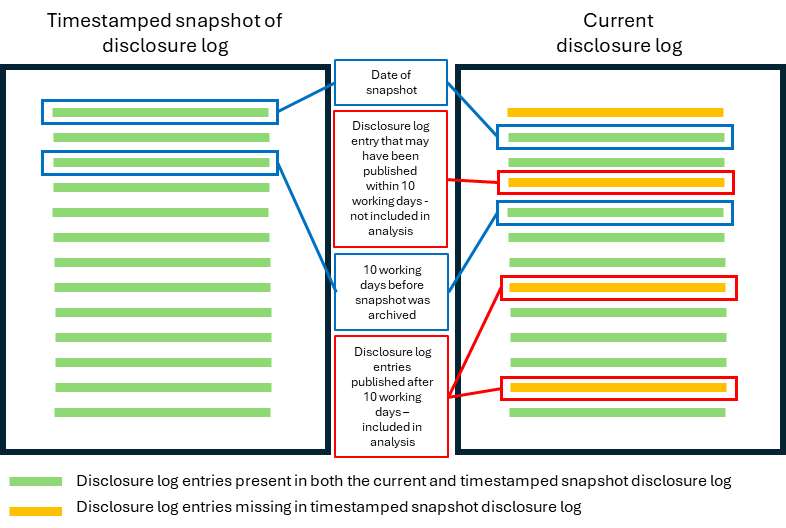
For the 16 agencies that only provided the access date on their disclosure logs, 4 could not be assessed using this method as these agencies did not have any usable timestamped snapshots taken during 2025. For the remaining agencies we assessed 1 to 4 snapshots depending on availability (Figure 11).
B.4: Assessing compliance with s 11C(6) using the RTK website and the publication date on the disclosure log
For agencies that provide only the publication date on their disclosure log, we used the date the correspondence to the applicant which contained the released documents was published on the RTK website as the access date. For each agency assessed by this method we examined all the FOI requests made in Q1 of 2025-2026 through the RTK website that resulted in the release of documents under the FOI Act. If there were no FOI requests in Q1 of 2025-2026 on the RTK website that resulted in the release of documents, we examined all other FOI requests that resulted in the release of documents from 2025. If there were no FOI requests that resulted in the release of documents made through the RTK website for an agency during 2025, we did not perform this analysis for that agency.
For each FOI request that resulted in the release of documents on the RTK website, we identified the corresponding disclosure log entry using the agency-assigned reference number or through using key word searches. Once the disclosure log entry was identified, we subtracted the publication date on the disclosure log from the access date of the RTK FOI request. Any disclosure log entries published 11 to 20 days after access was given were assessed with a calendar to account for weekends and all state and federal public holidays.
B.5: Assessing if all required information released under the FOI Act is published on the agency’s disclosure log using the RTK website
For every agency we examined all the FOI requests made in Q1 of 2025-2026 through the RTK website that resulted in the release of documents under the FOI Act. If there were no such FOI requests in Q1 of 2025-2026 on the RTK website, we examined all other FOI requests from 2025. If there were no FOI requests made through the RTK website that resulted in the release of documents for an agency during 2025, we did not perform this analysis for that agency.
For each FOI request on the RTK website that resulted in the release of documents, we identified the corresponding disclosure log entry using the agency-assigned reference number, or by searching for dates or key words identified in the request or released documents.
The average number of FOI requests assessed using this method was 3.2 per agency and ranged from 0 (2 agencies) to 20 (1 agency), with a median of 2.1 per agency.
B.6: Assessing if all required information released under the FOI Act is published on an agency’s disclosure log using IC review decisions that set aside or varied the original decision
For every agency we examined all the IC review decisions made in 2025 that set aside or varied an agency’s decision to refuse access to requested documents, where the request for access was to non-personal information. Each of these decisions was then examined by an experienced OAIC staff member to determine whether the IC decision would be likely to result in the release of documents that required publication on the disclosure log under s 11C of the FOI Act. We searched for the corresponding disclosure log entry using relevant dates and key words identified in the IC decision. We searched for both new disclosure log entries, and updates to the previous disclosure log entry for that FOI request where IC review decisions varied or set aside the agency’s decision.
Nine agencies had no relevant IC decisions in 2025 and were not assessed using this method. The OAIC was excluded from this analysis, as the IC does not review their own decisions. For the remaining 20 agencies, the average number of IC decisions assessed was 1.45 per agency and ranged from 1 (16 agencies) to 6 (1 agency), with a median of 1 per agency.
[1] Attorney-General’s Department, Commonwealth Integrity Strategy.
[3] Australian Public Service Commission, Integrity Agencies Group.
[4] Australian Public Service Commission, Trust in Australian public services: 2025 Annual Report | Australian Public Service Commission.
[5] OAIC, Agency FOI disclosure logs.
[6] Commonwealth, Parliamentary Debates, Senate, 13 May 2010, 2835 (Former Senator the Hon Joseph Ludwig) (Australian Information Commissioner Bill 2010; Freedom of Information Amendment (Reform) Bill 2010: Second reading).
[7] See also the Information Publication Scheme requirements in Pt II of the FOI Act which set out another platform for proactive publication of government-held documents.
[8]See, OAIC, Guidelines issued by the Australian Information Commissioner under s 93A of the Freedom of Information Act 1982 (FOI Guidelines).
[9] OAIC, Disclosure log desktop review (2021).
[10] The criteria assessed in both 2021 and in the current review was with respect to information provided with the disclosure log entries and whether the documents released were available by direct download.
[11] OAIC, Disclosure log desktop review (2021).
[12] Australian Public Service Commission, Stewardship guidance.
[13]Attorney-General’s Department, Commonwealth Integrity Strategy.
[14] Australian Public Service Commission, Integrity Agencies Group.
[15] Part 1, s 3(2) of the FOI Act.
[16] FOI Guidelines, Part 14: Disclosure log.
[17] OAIC, Disclosure log desktop review (2021).
[18] In 2021 34% of agencies required that members of the public contact them for access to any of the documents listed in their disclosure logs. In 2026 this decreased to 13%.
[19] In 2021 6% of agencies provided both dates for each disclosure log entry. In 2026 this had increased to 33%.
[20] Part III of the FOI Act outlines how members of the public can request access to eligible government information and Part I s 3 outlines the objects of the FOI Act.
[22] We only considered non-personal information due to exceptions to the publication requirement that apply to the personal, business, commercial, financial or professional affairs of any person, if it would be unreasonable to publish the information.
[24] IC review decisions that considered requests for access to personal information were not included in this analysis as a relevant exception to publication may have existed under s 11C(1) of the FOI Act.
[25] The OAIC provides guidance to agencies on using a readily identifiable ‘Access to information’ icon which assists in ensuring that disclosure logs are easily discoverable and that a consistent approach is adopted across government: Icons for Access to information.
[26] However, Annexure A to Part 14 of the FOI Guidelines (Disclosure log) has a sample disclosure log template that agencies may use.
[28] Australian National Audit Office (ANAO), Administration of the Freedom of Information Act 1982 by Selected Entities, section 2.86.
[32] We assessed FOI requests that had released documents found under the ‘successful request’ section for each agency on the RTK website. We did not distinguish between documents granted in full or in part.
[33] AustlII - Australian Information Commissioner (FOI decisions). We excluded IC review decisions that appeared to deal with personal information on the basis that the disclosure log requirements would not apply.
[34] OAIC, Disclosure log desktop review (2021).
[35] See also the matters the OAIC is required to report on under ss 30 -31 of the Australian Information Commissioner Act 2010.